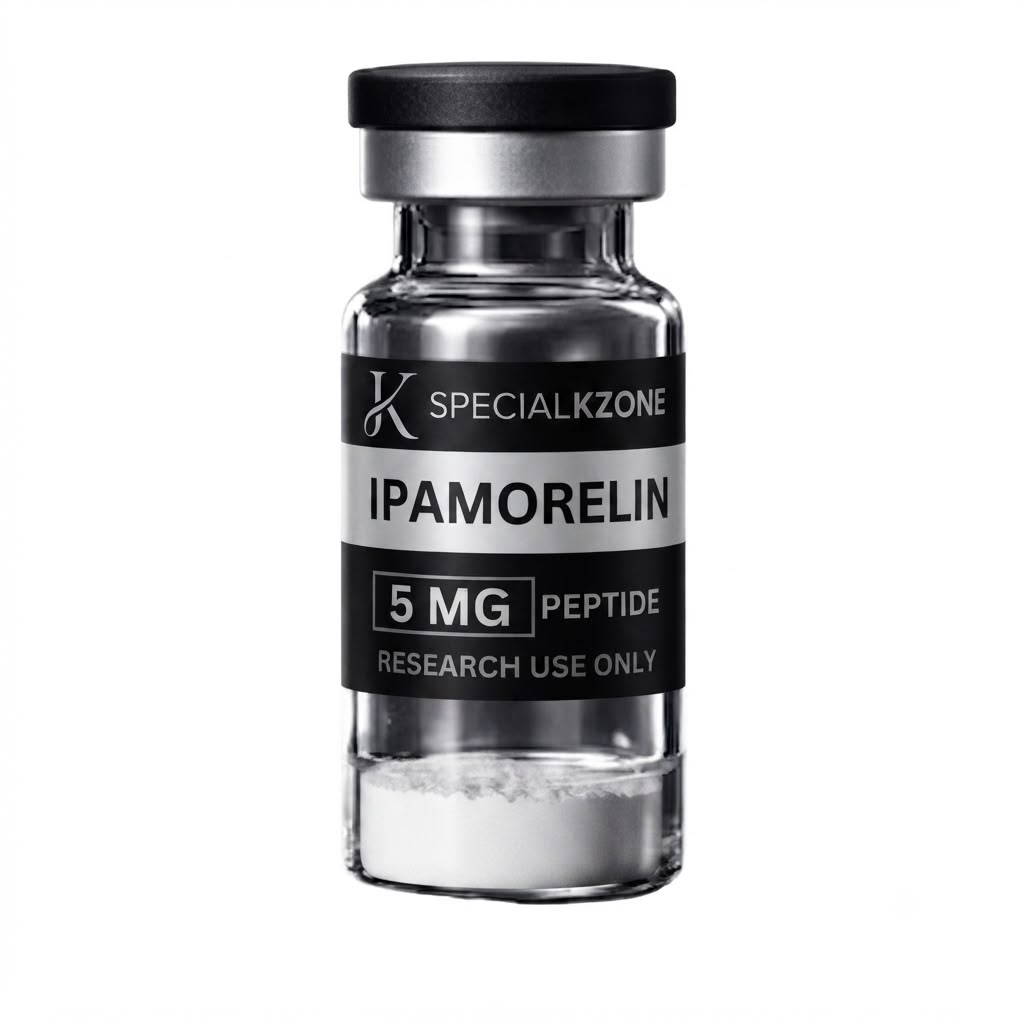
Ipamorelin 2mg – Selective Growth Hormone Secretagogue for Metabolic & Endocrine Research
Our pharmaceutical-grade Ipamorelin represents the gold standard in selective growth hormone secretagogue research, delivering a synthetic pentapeptide (Aib-His-D-2-Nal-D-Phe-Lys-NH₂) that mimics ghrelin’s GH-releasing properties without the unwanted side effects associated with first-generation GHRPs. Unlike non-selective secretagogues that stimulate prolactin, cortisol, and aldosterone release alongside growth hormone, Ipamorelin exhibits exquisite specificity for the growth hormone secretagogue receptor (GHS-R1a), triggering pulsatile GH release from anterior pituitary somatotrophs while preserving the natural feedback mechanisms that prevent desensitization. This 2mg lyophilized preparation provides researchers with a clean tool for investigating endogenous GH axis function without the confounding endocrine variables that compromise data integrity in metabolic and anti-aging studies.
As a ghrelin mimetic, Ipamorelin activates the same GHS-R1a receptors as the endogenous appetite-stimulating hormone, yet it avoids significant stimulation of corticotrophs or lactotrophs. This selectivity proves crucial for research protocols requiring isolated GH stimulation—such as studies examining lipolysis, nitrogen retention, or IGF-1 synthesis without the immunosuppressive or hypertensive effects of elevated cortisol. When reconstituted with bacteriostatic water, this pentapeptide enables precise dose-response investigations into the somatotropic axis, offering superior signal-to-noise ratios compared to hexapeptide alternatives like GHRP-6 or GHRP-2.
For laboratories studying metabolic syndrome, sarcopenia, or bone density regeneration, Ipamorelin provides a research-friendly alternative to exogenous growth hormone administration, allowing investigation of endogenous pulse patterns that preserve normal feedback loops. Its synergy with GHRH analogs—exemplified in our CJC-1295 No DAC Ipamorelin blend—creates amplified GH responses through complementary mechanisms, making it essential for both standalone GH axis research and combination therapy protocols.
H2: Molecular Mechanisms & Selective Pharmacology
Ipamorelin (molecular weight 711.85 Da) functions as a competitive agonist at the GHS-R1a receptor, a G-protein coupled receptor expressed primarily on somatotroph cells in the anterior pituitary and on hypothalamic neurons involved in appetite regulation. The peptide’s unique structure—featuring an N-terminal amino-isobutyric acid (Aib) and a D-2-naphthylalanine at position 3—confers high binding affinity (Ki ~2 nM) while sterically hindering interactions with receptors responsible for prolactin and ACTH secretion.
Pulsatile GH Release:
Unlike continuous GH infusion which causes receptor downregulation and IGF-1 resistance, Ipamorelin stimulates natural pulsatile secretion patterns with approximately 40-70 minute half-life in research models. This pulsatility preserves the normal ultradian rhythm of GH release, essential for research investigating tissue-specific IGF-1 generation versus hepatic-derived systemic IGF-1. The peptide does not significantly increase appetite in research subjects—a distinct advantage over GHRP-6—allowing metabolic studies without confounding caloric intake variables.
Preservation of Feedback Mechanisms:
Critically, Ipamorelin does not suppress endogenous GHRH secretion or somatostatin tone, nor does it create the “crash” associated with GHRP-2’s cortisol elevation. This preserves the hypothalamic-pituitary negative feedback loops, making it suitable for long-term research protocols examining sustained GH axis stimulation without the pituitary desensitization observed with continuous GnRH analogs or high-dose GH administration.
Bone & Connective Tissue Effects:
Beyond GH-mediated effects, Ipamorelin demonstrates direct activity on osteoblast proliferation and collagen synthesis through local IGF-1 generation. Research indicates enhanced bone mineral density and improved calcium retention, distinguishing it from purely metabolic interventions like [GLP-3 RT](https://specialkzone.com/product/glp-3-rt-10mg/) which focus on energy expenditure rather than structural tissue deposition.
Research Applications & Laboratory Protocols
Growth Hormone Deficiency Models:
The primary application for Ipamorelin involves investigating partial GH deficiency and age-related somatopause. Research protocols examine whether selective GHS-R1a stimulation can restore youthful GH pulse amplitude without the side effect profiles of exogenous GH (edema, insulin resistance, carpal tunnel syndrome). Studies focus on body composition changes—specifically visceral adipose reduction and lean mass preservation—in models of metabolic syndrome.
Metabolic Syndrome & Lipolysis Research:
Ipamorelin stimulates lipolysis through GH-mediated hormone-sensitive lipase activation while simultaneously improving lipid profiles. Unlike [CJC-1295 No DAC](#] which must be paired with a GHRP for optimal effect, Ipamorelin functions effectively as a standalone secretagogue, allowing researchers to isolate GH-specific metabolic effects from GHRH-mediated influences on sleep architecture or cortisol rhythms.
Bone Density & Osteoporosis Studies:
Research utilizing Ipamorelin examines trabecular bone formation and cortical thickness enhancement through mechanisms distinct from bisphosphonates or parathyroid hormone analogs. The peptide’s ability to stimulate osteoblastogenesis without simultaneous osteoclast activation makes it valuable for investigating net bone accrual in osteoporosis models.
Anti-Aging & Cellular Maintenance:
While not a structural repair peptide like [BPC-157](#], Ipamorelin influences cellular maintenance through enhanced protein synthesis, improved cellular hydration, and optimized nitrogen balance. Research explores whether maintained GH pulsatility can preserve thymic function, skin collagen density, and cognitive performance in aging models without the pro-aging effects of continuous GH exposure.
Combination Therapy Research:
When stacked with GHRH analogs, Ipamorelin produces synergistic GH release exceeding the sum of individual effects. Research investigates optimal dosing ratios (typically 1:1 mcg ratios with CJC-1295 No DAC to maximize GH pulse amplitude while minimizing receptor desensitization—a combination approach that mimics natural hypothalamic-pituitary coordination.
Product Specifications & Analytical Verification
- Chemical Name: Ipamorelin (NNC 26-0161)
- Sequence: Aib-His-D-2-Nal-D-Phe-Lys-NH₂
- Synonyms: Ipamorelin acetate, NNC 26-0161
- Molecular Formula: C₃₈H₄₉N₉O₅
- Molecular Weight: 711.85 g/mol (free base)
- Total Content: 2mg per vial (lyophilized powder, acetate salt)
- Structure: Synthetic pentapeptide with modified amino acids
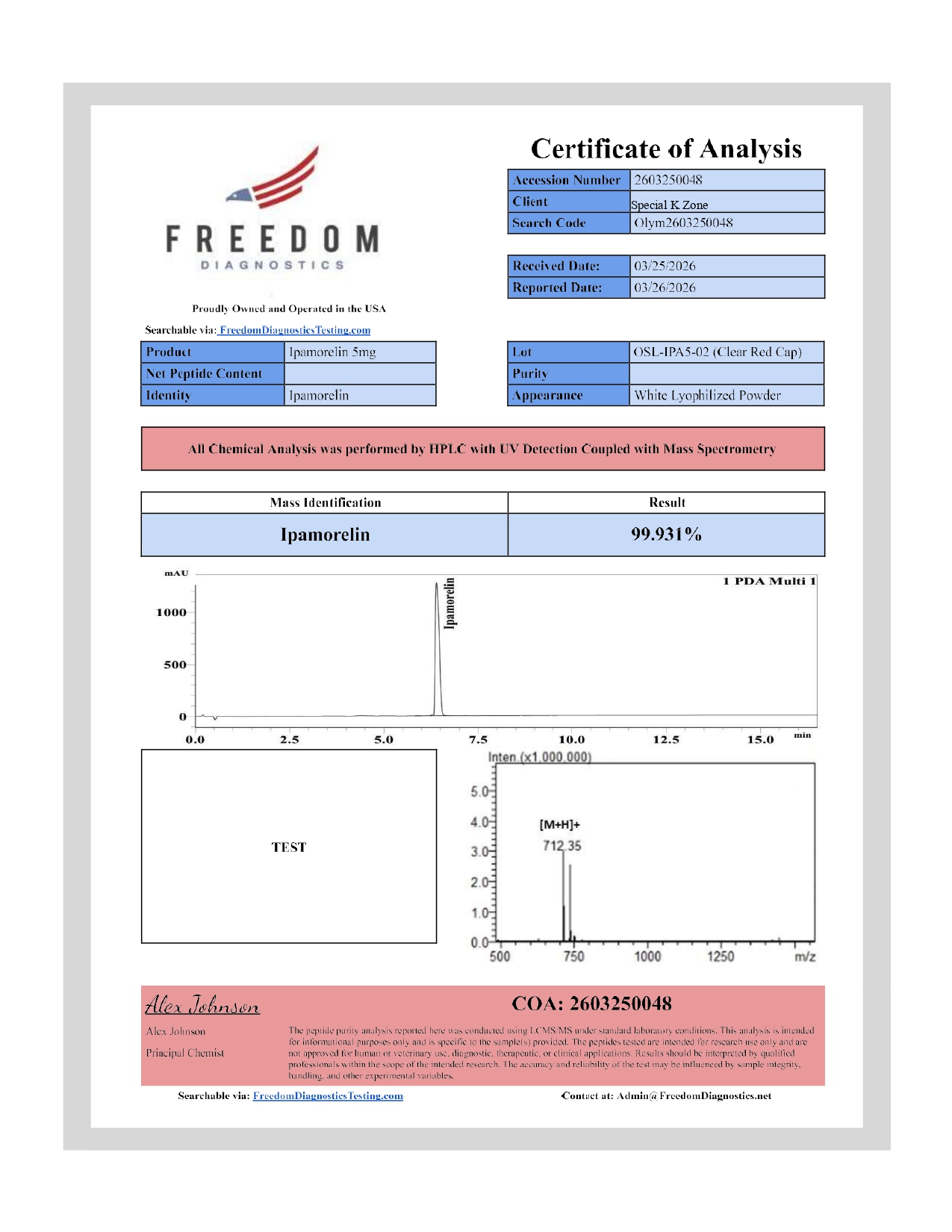
- Purity: ≥99% (HPLC verified)
- Appearance: White fluffy lyophilized powder
- Solubility: Highly soluble in aqueous solutions, optimal in bacteriostatic water
- Storage: -20°C stable (lyophilized), 2-8°C after reconstitution
- Reconstituted Stability: 14-21 days refrigerated when prepared with appropriate preservatives
Quality Control Notes:
Each batch verified via mass spectrometry for correct molecular weight (712.4 [M+H]+) and absence of truncation products. Biological activity confirmed through GH release assays in rat pituitary cell cultures, ensuring EC₅₀ values consistent with literature standards (1-10 nM range).
Reconstitution, Dosing & Administration Protocols
Preparation Guidelines:
Reconstitute Ipamorelin 2mg with 1-2ml of bacteriostatic water to create a 1-2mg/ml stock solution. The peptide demonstrates excellent aqueous solubility without requiring acidic buffers; gentle swirling for 30 seconds typically achieves complete dissolution. Unlike larger proteins such as [IGF-1 LR3](#], Ipamorelin does not require albumin pre-coating of containers due to its small size and hydrophilic nature.
Research Dosing Parameters:
Typical research concentrations range from 100-300 mcg per administration in rodent models, administered 1-3 times daily depending on study duration and desired GH pulse frequency. For synergy studies with GHRH analogs, dosages are typically matched (e.g., 100mcg Ipamorelin + 100mcg GHRH analog) to investigate receptor cross-talk and intracellular calcium signaling amplification.
Timing Considerations:
Ipamorelin research protocols often administer the peptide 30-45 minutes prior to assessment endpoints to capture peak GH release. For metabolic studies involving glucose tolerance, researchers must account for GH’s transient insulin-antagonistic effects which typically manifest 2-3 hours post-administration.
Storage of Reconstituted Solution:
Unlike [GHK-Cu](#] which requires strict metal-ion avoidance, Ipamorelin tolerates standard laboratory plastics and glassware. However, refrigerated storage at 2-8°C is essential to prevent microbial growth and slow any hydrolysis of the C-terminal amide bond.
Comparative Analysis: Ipamorelin vs. Alternative Secretagogues
Ipamorelin vs. GHRP-2 & GHRP-6:
While hexapeptide GHRPs stimulate GH release, they concurrently elevate prolactin (via weak D2 receptor agonism) and cortisol (via ACTH stimulation). Ipamorelin’s pentapeptide structure eliminates these off-target effects, providing “cleaner” GH data. Additionally, GHRP-6 induces significant appetite stimulation through hypothalamic NPY/AgRP neuron activation—desirable for cachexia research but confounding for metabolic studies requiring caloric control.
Ipamorelin vs. CJC-1295 (GHRH Analogs):
[CJC-1295 No DAC](#] stimulates GH release through GHRH receptors, requiring endogenous ghrelin signaling for optimal effect. Ipamorelin bypasses somatostatin inhibition through GHS-R1a activation, creating complementary mechanisms. Research comparing individual administration versus combined protocols reveals synergistic amplification (1+1=3 effect) due to simultaneous stimulation of distinct receptor populations on somatotroph membranes.
Ipamorelin vs. BPC-157:
These peptides represent fundamentally different research categories. [BPC-157](#] focuses on structural healing through angiogenesis and extracellular matrix modulation, while Ipamorelin targets endocrine modulation of growth and metabolism. However, combination research investigates whether optimized GH status (via Ipamorelin) accelerates the tissue repair mechanisms initiated by [BPC-157](#], particularly in tendon-to-bone healing models where both systemic anabolic status and local angiogenesis prove critical.
Safety Considerations & Research Limitations
Water Retention & Edema:
As with all GH-stimulating compounds, Ipamorelin research may observe dose-dependent extracellular fluid retention due to GH’s anti-natriuretic effects and IGF-1-mediated sodium retention. This manifests as transient weight gain distinct from lean tissue accretion, requiring careful body composition analysis (DEXA or hydrostatic weighing) rather than simple mass measurements.
Insulin Sensitivity:
Chronic GH elevation induces insulin resistance via increased lipolysis and direct interference with insulin receptor signaling. Research protocols extending beyond 4 weeks should include glucose tolerance testing and HOMA-IR calculations to distinguish transient metabolic adaptation from pathological insulin resistance.
Desensitization Potential:
While Ipamorelin preserves feedback mechanisms better than non-selective GHRPs, continuous high-dose administration may still induce GHS-R1a downregulation. Research suggests pulsatile administration (3x daily) maintains receptor sensitivity better than continuous infusion, mirroring natural GH physiology.
Frequently Asked Research Questions
Why does Ipamorelin not increase cortisol like GHRP-2?
The pentapeptide structure lacks the structural motifs that confer affinity for corticotroph ACTH release pathways. Ipamorelin binds GHS-R1a with high selectivity, whereas GHRP-2 interacts with additional receptor subtypes or signaling pathways that trigger HPA axis activation.
Can Ipamorelin be used in female research models without prolactin concerns?
Yes, this is a primary research advantage. Unlike GHRP-6 which stimulates prolactin release (potentially causing mammary effects or menstrual disruption in chronic studies), Ipamorelin maintains prolactin levels within baseline parameters, making it suitable for gender-comparative metabolic research.
What is the optimal pairing with CJC-1295 No DAC?
Research indicates a 1:1 mcg ratio (e.g., 100mcg each) administered simultaneously produces synergistic GH pulses exceeding either compound alone by 2-3 fold. This mirrors the natural physiological coordination between hypothalamic GHRH and gastric ghrelin.
Does Ipamorelin affect sleep architecture like other GHRPs?
While GH release naturally correlates with slow-wave sleep, Ipamorelin does not significantly alter sleep staging like [DSIP](#] or benzodiazepine research compounds. Any sleep changes observed typically result from metabolic effects rather than direct CNS action.
How does this differ from Hexarelin?
Hexarelin stimulates cardiac receptors (CD36) in addition to GHS-R1a, producing cardioprotective effects but complicating metabolic research. Ipamorelin lacks this cardiac activity, providing purer metabolic and growth data without cardiovascular confounders.
IPAMORELIN is a research compound in lyophilized powder form for laboratory research, testing, and analytical applications.
-
Compound: IPAMORELIN
-
Quantity: 5 mg
-
Purity: ≥99% (HPLC Certified)
-
Form: Lyophilized powder
-
Appearance: White to off-white powder
-
Solubility: Soluble in laboratory-grade sterile water
-
COA: Included in product image gallery
Reviews
There are no reviews yet.