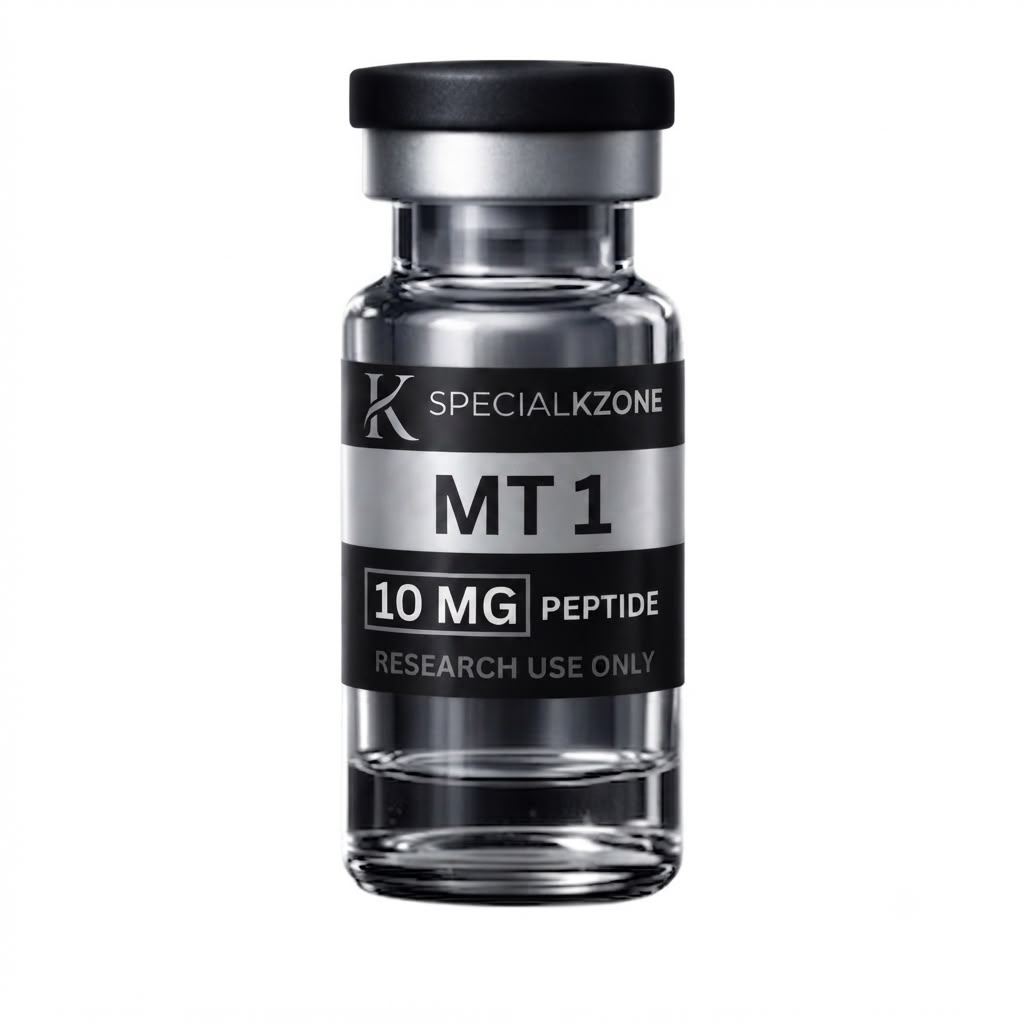
Melanotan 1 (Afamelanotide) 10mg – Clinical-Grade Photoprotection for EPP & Dermatological Research
Our pharmaceutical-grade Melanotan 1 (Afamelanotide) provides research laboratories with the identical linear tridecapeptide structure that revolutionized photoprotection medicine, offering 10mg of this clinically validated alpha-MSH analog for investigation into erythropoietic protoporphyria (EPP), solar urticaria, and photodynamic therapy protection. As the first synthetic melanotropin to achieve regulatory approval for clinical photoprotection (Scenesse®), Afamelanotide represents the gold standard for MC1R-selective research, distinguishing itself from recreational tanning compounds through its rigorous pharmacological profile and therapeutic targeting of pathological photosensitivity rather than cosmetic pigmentation.
Unlike the cyclic analog [Glow (Melanotan II)](https://specialkzone.com/product/glow/), which stimulates multiple melanocortin receptors and produces central nervous system side effects, Melanotan 1 (Ac-Ser-Tyr-Ser-Nle-Glu-His-D-Phe-Arg-Trp-Gly-Lys-Pro-Val-NH₂) specifically targets cutaneous melanocortin-1 receptors to induce eumelanin synthesis without appetite suppression, sexual arousal, or blood pressure changes. This selectivity makes it indispensable for research into medically necessary photoprotection, where confounding variables from central melanocortin activation would invalidate clinical endpoints. When reconstituted with bacteriostatic water, this 10mg preparation enables extended research protocols examining the pharmacokinetics of sustained photoprotection, including the “hard-wired” melanin response that provides inherent SPF-equivalent protection independent of behavioral sun avoidance.
For photobiology researchers and dermatology laboratories investigating the boundary between pharmacological intervention and physical photoprotection, Melanotan 1 offers a bridge between basic science and clinical application, providing the same peptide sequence used in Phase III trials to demonstrate that pharmacologic tanning can prevent anaphylactoid reactions in porphyric patients and reduce phototoxicity in photodynamic therapy models.
Clinical Development & Erythropoietic Protoporphyria Research
Melanotan 1 (Afamelanotide) emerged from decades of melanocortin research as the first peptide to successfully navigate clinical trials for photosensitivity disorders. Erythropoietic protoporphyria (EPP), characterized by ferrochelatase deficiency and protoporphyrin IX accumulation, causes severe burning pain and potential liver damage upon exposure to visible light (400-410 nm). Research utilizing Afamelanotide demonstrates that induced eumelanin density can attenuate this specific wavelength range, effectively filtering the Soret band excitation that triggers porphyrin-mediated cellular damage.
Photodynamic Therapy (PDT) Protection:
Beyond EPP, Melanotan 1 research extends to photodynamic therapy patients receiving photosensitizing agents like porfimer sodium or aminolevulinic acid. These patients experience severe photosensitivity for weeks post-treatment. Research investigates whether preemptive MT-1 administration can induce protective melanin levels without compromising therapeutic light delivery to target tissues, potentially expanding the therapeutic window for dermatological oncology treatments.
Mechanistic Distinction from Sunscreen:
Unlike topical sunscreens that require reapplication and provide limited UVA/UVB filtration, Melanotan 1 stimulates endogenous melanin distributed throughout the epidermis, offering protection against the entire solar spectrum including visible light and near-infrared—wavelengths that chemical sunscreens cannot effectively block. Research compares this “biological sunscreen” approach to traditional photoprotection, examining quality-of-life outcomes in patients who cannot tolerate chemical filters or physical barriers.
H2: Molecular Mechanisms & Eumelanin Induction
Melanotan 1 activates the melanocortin-1 receptor (MC1R) on melanocytes, triggering the cAMP/PKA signaling cascade that upregulates microphthalmia-associated transcription factor (MITF). Unlike [GHK-Cu](#], which influences skin through copper ion transport and collagen synthesis, MT-1 specifically drives melanogenic enzyme expression: tyrosinase, TYRP-1, and DCT. This results in increased eumelanin deposition within melanosomes, which transfer to keratinocytes to form a supranuclear cap that shields DNA from UV-induced pyrimidine dimer formation.
The Eumelanin Advantage:
Research indicates that Afamelanotide preferentially stimulates eumelanin (brown/black, photoprotective) over pheomelanin (red/yellow, photosensitizing). This shift in melanin type correlates with reduced reactive oxygen species generation upon light exposure, providing antioxidant protection beyond simple physical shading. Studies quantify this protection through minimal erythema dose (MED) testing, typically demonstrating 3-5 fold increases in UV tolerance following 10-14 days of administration.
Comparison with Structural Skin Peptides:
While [GHK-Cu](#] addresses photoaging through collagen remodeling and antioxidant activity, and [BPC-157](#] promotes wound healing through angiogenesis, Melanotan 1 specifically addresses the pigmentary defense system. Research combining these approaches investigates whether photoprotection (MT-1) combined with structural repair (GHK-Cu) offers superior outcomes in photoaged skin models compared to single-agent interventions.
Product Specifications & Pharmaceutical Standards
- Chemical Name: Afamelanotide; [Nle⁴, D-Phe⁷]-alpha-MSH; Melanotan 1
- Sequence: Ac-Ser-Tyr-Ser-Nle-Glu-His-D-Phe-Arg-Trp-Gly-Lys-Pro-Val-NH₂
- Molecular Formula: C₇₈H₁₁₁N₂₁O₁₉
- Molecular Weight: 1,646.85 g/mol
- Total Content: 10mg per vial (lyophilized powder)
- Structure: Linear tridecapeptide (13 amino acids)
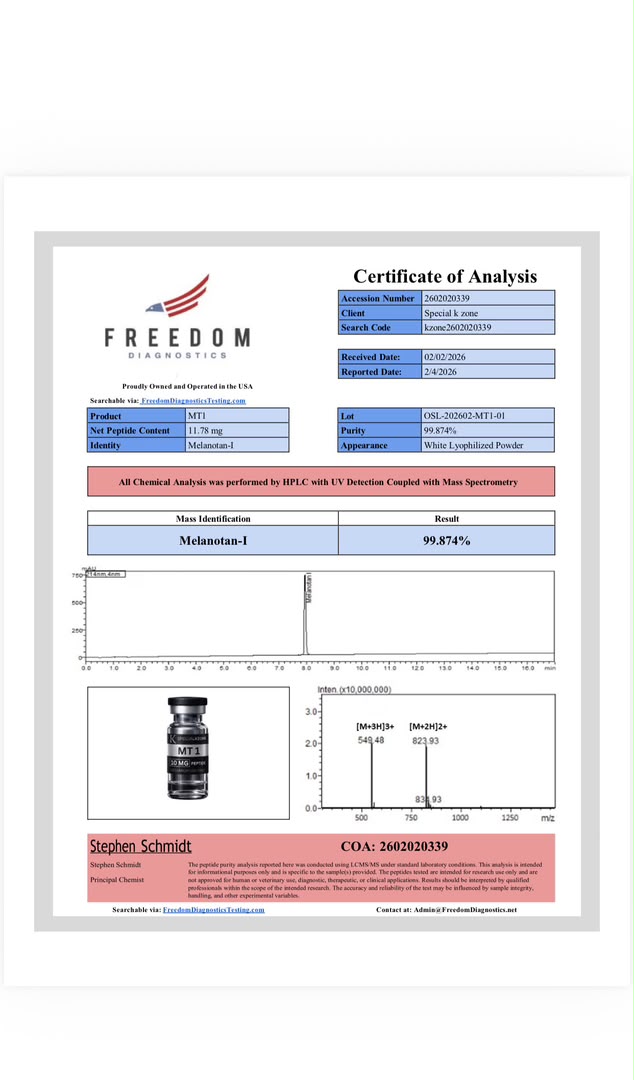
- Purity: ≥99.5% (HPLC verified, clinical-grade)
- Appearance: White to off-white fluffy lyophilized powder
- Solubility: Soluble in aqueous solutions (water, saline, bacteriostatic water)
- Storage: -20°C stable (lyophilized), 2-8°C after reconstitution
- Reconstituted Stability: 14 days at 2-8°C when prepared with preservatives
Quality Control:
Each batch verified via mass spectrometry for molecular weight (1,647.6 [M+H]+) and peptide mapping. Purity confirmed through RP-HPLC with diode array detection. Biological activity assessed through melanin synthesis assays in B16-F10 melanoma cells, ensuring EC₅₀ values <5 nM for tyrosinase upregulation.
Research Protocols & Administration Guidelines
Reconstitution:
Reconstitute Melanotan 1 10mg with 2ml of bacteriostatic water to create a 5mg/ml stock solution. The peptide exhibits excellent aqueous solubility at neutral pH without requiring acidic buffers. For extended stability in research settings, prepare aliquots for single use to prevent oxidation of the tryptophan residue at position 9.
Dosing Paradigms:
Clinical translation research typically employs 0.16 mg/kg subcutaneous administration every 2-3 days during loading phases, followed by maintenance dosing. For photoprotection research, protocols generally require 7-14 days of administration to achieve measurable melanin density, with peak photoprotection occurring at 2-3 weeks.
Photoprotection Assessment:
Research endpoints include:
- Minimal erythema dose (MED) determination with solar simulators
- Reflectance spectroscopy for melanin index quantification
- Histological assessment of epidermal melanin distribution (Fontana-Masson staining)
- Quality-of-life metrics for photosensitivity disorders
Combination Research:
Studies investigating Melanotan 1 alongside traditional photoprotection (sunscreens, protective clothing) examine additive versus synergistic effects. Unlike [Glow (Melanotan II)](https://specialkzone.com/product/glow/) which requires careful monitoring for side effects that could confound research data, MT-1’s selectivity allows for cleaner assessment of photoprotection endpoints without central nervous system variables.
Comparative Analysis: Melanotan 1 vs. Alternative Compounds
Melanotan 1 vs. Melanotan II (Glow):
While both stimulate melanogenesis, [Glow (MT-II)](#] is a cyclic heptapeptide with affinity for MC1R, MC3R, MC4R, and MC5R, producing side effects including appetite suppression, sexual arousal, and blood pressure changes. Melanotan 1 is a linear tridecapeptide with exclusive MC1R selectivity, providing pure photoprotection research data. The linear structure also confers longer duration of action due to reduced renal clearance compared to the compact cyclic structure of MT-II.
Melanotan 1 vs. GHK-Cu:
[GHK-Cu](#] (Copper Peptide) represents a distinct approach to skin health, focusing on collagen synthesis, wound healing, and antioxidant protection through copper ion transport. Melanotan 1 specifically addresses photoprotection through melanin induction. Research comparing these mechanisms investigates whether preventing UV damage (MT-1) or repairing UV damage (GHK-Cu) proves more effective for long-term skin health, with combination protocols examining potential synergy.
Melanotan 1 vs. Traditional Photoprotection:
Chemical sunscreens (oxybenzone, avobenzone) absorb specific UV wavelengths but require frequent reapplication and may cause allergic reactions. Physical blockers (zinc oxide, titanium dioxide) provide broad-spectrum protection but are cosmetically unacceptable to many users. Melanotan 1 research investigates whether induced melanin can provide continuous, broad-spectrum protection without compliance issues or cosmetic concerns, particularly for patients with photosensitivity disorders who cannot tolerate topical products.
Safety Considerations & Research Limitations
Melanocytic Activation:
As with all melanogenic agents, research must monitor for changes in melanocytic nevi. While Melanotan 1 stimulates melanin synthesis rather than melanocyte proliferation per se, long-term studies should include dermatological monitoring for atypical mole changes or new pigmented lesions.
Duration of Protection:
Unlike daily sunscreen application, MT-1 induces melanin that persists for weeks to months after cessation, depending on epidermal turnover rates. Research protocols must account for this persistence when designing washout periods between treatment phases or when transitioning to alternative photoprotection methods.
Patient-Specific Factors:
Research indicates variable responses based on MC1R genotype. Red-haired individuals (R/R variant) show reduced response to Melanotan 1 due to receptor polymorphisms, while darker skin types demonstrate enhanced baseline melanin but may still benefit from pharmacological darkening. Study designs should stratify subjects by MC1R status to account for this pharmacogenetic variability.
Frequently Asked Research Questions
How does Melanotan 1 differ from cosmetic tanning peptides?
Melanotan 1 (Afamelanotide) is the pharmaceutical-grade, clinically tested linear peptide approved for EPP treatment. “Cosmetic tanning peptides” typically refer to [Melanotan II](#] or unregulated analogs with different receptor profiles and safety data. MT-1 specifically targets MC1R without central nervous system effects.
What is the onset of photoprotection in research models?
Visible tanning typically appears within 7-10 days, with measurable photoprotection (MED doubling) achieved by day 14-21 of administration. Maximal protection correlates with melanosome transfer to suprabasal keratinocytes.
Can Melanotan 1 be used in combination with photodynamic therapy research?
Yes, research investigates MT-1 as a protective agent for patients undergoing PDT with photosensitizers like aminolevulinic acid. The induced melanin can protect surrounding healthy tissue while allowing therapeutic light penetration to target lesions, though timing protocols must account for melanin distribution in target tissues.
How is this stored for long-term research?
Lyophilized powder remains stable at -20°C for 24 months. Once reconstituted with bacteriostatic water, store at 2-8°C and use within 14 days to prevent microbial contamination and oxidative degradation of the tryptophan residue.
Does Melanotan 1 provide protection against visible light and UVA?
Yes, unlike chemical sunscreens that primarily target UVB and short UVA, eumelanin induced by MT-1 provides broad-spectrum protection including visible light (400-700nm) and long UVA (UVA1, 340-400nm), making it valuable for research into visible light-induced photosensitivity and pigmentary disorders.
Melanotan 1 is a research compound in lyophilized powder form for laboratory research, testing, and analytical applications.
-
Compound: Melanotan 1
-
Quantity: 10 mg
-
Purity: ≥99% (HPLC Certified)
-
Form: Lyophilized powder
-
Appearance: White to off-white powder
-
Solubility: Soluble in laboratory-grade sterile water
-
COA: Included in product image gallery
Reviews
There are no reviews yet.