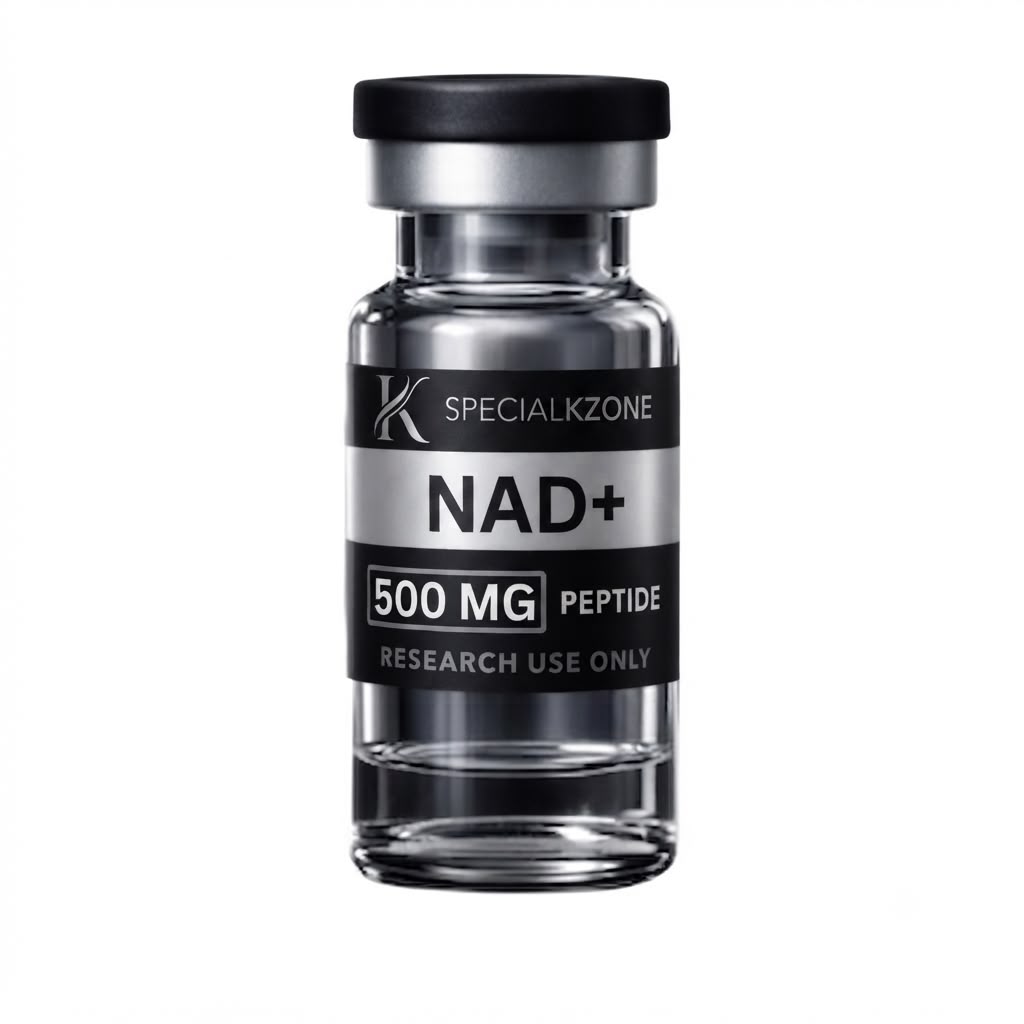
NAD+ 500mg – Nicotinamide Adenine Dinucleotide for Metabolic & Longevity Research
Intro Paragraph (250 words)
Our pharmaceutical-grade NAD+ (Nicotinamide Adenine Dinucleotide, oxidized form) delivers the central coenzyme of cellular metabolism, providing 500mg of high-purity dinucleotide for investigation into sirtuin activation, DNA repair mechanisms, and the mitochondrial dysfunction underlying metabolic disease and aging. Unlike peptide-based interventions such as MOTS-c or structural repair agents like BPC-157, NAD+ functions as an essential redox cofactor and signaling molecule, shuttling electrons between metabolic pathways while serving as the obligate substrate for sirtuins (SIRT1-7), poly(ADP-ribose) polymerases (PARPs), and CD38/NADases. This non-peptide research compound has emerged as a critical focus of geroscience research, addressing the age-dependent decline in NAD+ levels (dropping 50% by age 50) that impairs oxidative phosphorylation, compromises genomic stability, and diminishes cellular stress resistance.
As an oxidized pyridine nucleotide, NAD+ exists in dynamic equilibrium with its reduced form (NADH), maintaining the redox potential that drives ATP synthesis through the electron transport chain. Research utilizing exogenous NAD+ investigates whether direct administration can bypass rate-limiting bottlenecks in the salvage pathway (NAMPT-mediated nicotinamide conversion), restoring the NAD+/NADH ratio essential for metabolic flexibility. When reconstituted with bacteriostatic water, this preparation enables precise investigation into the “NAD World” hypothesis—the theory that systemic NAD+ decline coordinates organ dysfunction during aging through disrupted intercellular communication and mitochondrial-nuclear signaling.
For laboratories studying caloric restriction mimetics, metabolic syndrome pathophysiology, or the DNA damage response, NAD+ offers a fundamental biochemical tool that complements peptide-based growth factors and mitochondrial-derived peptides, addressing the energy currency and epigenetic regulation that enable cellular repair mechanisms to function.
Redox Biochemistry & Metabolic Integration
NAD+ (C₂₁H₂₇N₇O₁₄P₂, MW 663.43 g/mol) consists of two nucleotides—nicotinamide and adenine—joined through phosphate groups. Its primary biochemical function involves reversible hydride acceptance (reduction to NADH) during catabolic reactions, transferring electrons to the mitochondrial electron transport chain for oxidative phosphorylation. However, contemporary research focuses equally on NAD+ as a consumed substrate for signaling enzymes that regulate longevity and stress responses.
Sirtuin Activation:
Silent information regulator (Sirtuin) proteins (SIRT1-7) are NAD+-dependent deacetylases and mono-ADP-ribosyltransferases that link metabolic status to epigenetic regulation. SIRT1 (nuclear) and SIRT3 (mitochondrial) require NAD+ to remove acetyl groups from histones and metabolic enzymes, coordinating the cellular response to nutrient availability. Research indicates that NAD+ availability is rate-limiting for sirtuin activity; thus, supplementation research investigates whether restoring youthful NAD+ levels can mimic caloric restriction effects—including improved insulin sensitivity, enhanced mitochondrial biogenesis, and reduced inflammation—without dietary intervention.
PARP-Mediated DNA Repair:
Poly(ADP-ribose) polymerases (PARP1/2) consume NAD+ to detect DNA strand breaks and recruit repair machinery. While essential for genomic integrity, chronic PARP activation (as occurs with accumulated DNA damage in aging) can deplete NAD+ pools, creating a vicious cycle of energy crisis and genomic instability. Research utilizing NAD+ examines whether substrate supplementation can support PARP function during acute DNA damage (radiation protection) while investigating inhibitors to prevent excessive consumption during chronic oxidative stress.
CD38 and the NADase Axis:
The ectoenzyme CD38 (and related NADases) hydrolyzes NAD+ to cyclic ADP-ribose (cADPR) and subsequently ADP-ribose, regulating calcium signaling but also contributing to age-related NAD+ decline. Research distinguishes between beneficial signaling roles of CD38 in immune activation and its pathological consumption of NAD+ during inflammaging, with NAD+ administration studies examining whether substrate overload can overcome enzymatic degradation.
Research Applications & Therapeutic Models
Aging & Longevity Studies:
The flagship application for NAD+ research involves reversing or slowing biomarkers of aging. Studies demonstrate that restoring NAD+ levels in aged animal models improves muscle function, enhances cognitive performance, and extends healthspan. Research compares direct NAD+ administration versus precursor strategies (NMN, NR), investigating bioavailability and tissue distribution differences. Unlike MOTS-c, which stimulates mitochondrial biogenesis through mitokine signaling, NAD+ provides the actual substrate for oxidative phosphorylation and sirtuin-mediated mitochondrial maintenance, potentially offering complementary or synergistic benefits in combination protocols.
Metabolic Syndrome & Insulin Resistance:
NAD+ research extensively examines type 2 diabetes and obesity models, where the NAD+/NADH ratio is often disturbed due to hyperglycemia-induced redox stress. Restoration of NAD+ levels improves glucose-stimulated insulin secretion in pancreatic beta cells (through SIRT1-mediated UCP2 inhibition) and enhances insulin sensitivity in skeletal muscle through improved mitochondrial function. Research contrasts this metabolic approach with growth hormone axis modulation using [CJC-1295](https://specialkzone.com/product/cjc-no-dac-ipamorelin/), examining whether cellular energy status (NAD+) or anabolic hormone milieu (GH/IGF-1) predominates in metabolic disease reversal.
Neurodegenerative Disease Models:
Mitochondrial dysfunction and impaired DNA repair characterize Alzheimer’s, Parkinson’s, and Huntington’s diseases. NAD+ research investigates whether restoring neuronal energy metabolism can prevent axonal degeneration, reduce amyloid-beta toxicity, and improve cognitive outcomes. Studies focus on the SIRT3-mediated reduction of mitochondrial reactive oxygen species and the PARP-mediated repair of neuronal DNA damage accumulated with age. Unlike [BPC-157](#], which promotes neuronal survival through growth factor-like mechanisms, NAD+ addresses the bioenergetic collapse and epigenetic dysregulation that precede structural neuronal loss.
Radiation Protection & DNA Damage:
As a PARP substrate, NAD+ is essential for the DNA damage response following ionizing radiation. Research explores NAD+ loading prior to radiation exposure to enhance repair capacity in hematopoietic stem cells and gastrointestinal crypt cells, potentially serving as a radioprotective agent for therapeutic radiation protocols or environmental/occupational exposure models. This protective mechanism differs from direct antioxidants like [Glutathione](#], which scavenge free radicals, whereas NAD+ enables the enzymatic repair of the resulting DNA damage.
Product Specifications & Molecular Characteristics
- Chemical Name: Nicotinamide Adenine Dinucleotide (Oxidized Form); NAD+; β-NAD+
- Molecular Formula: C₂₁H₂₇N₇O₁₄P₂
- Molecular Weight: 663.43 g/mol (free acid form)
- Total Content: 500mg per vial (lyophilized powder)
- Structure: Dinucleotide (Nicotinamide mononucleotide + Adenosine monophosphate)
- Purity: ≥98% (HPLC verified, UV spectrophotometry at 259nm)
- Appearance: White to off-white crystalline or amorphous powder; may exhibit slight yellow tint upon oxidation
- Solubility: Freely soluble in water (up to 100mg/ml); soluble in physiological saline
- Storage: -20°C stable (lyophilized), protect from moisture and light
- Reconstituted Stability: 7 days at 2-8°C (prepare fresh solutions for optimal activity)
- Counter-ion: Typically provided as sodium or free acid salt
Quality Control:
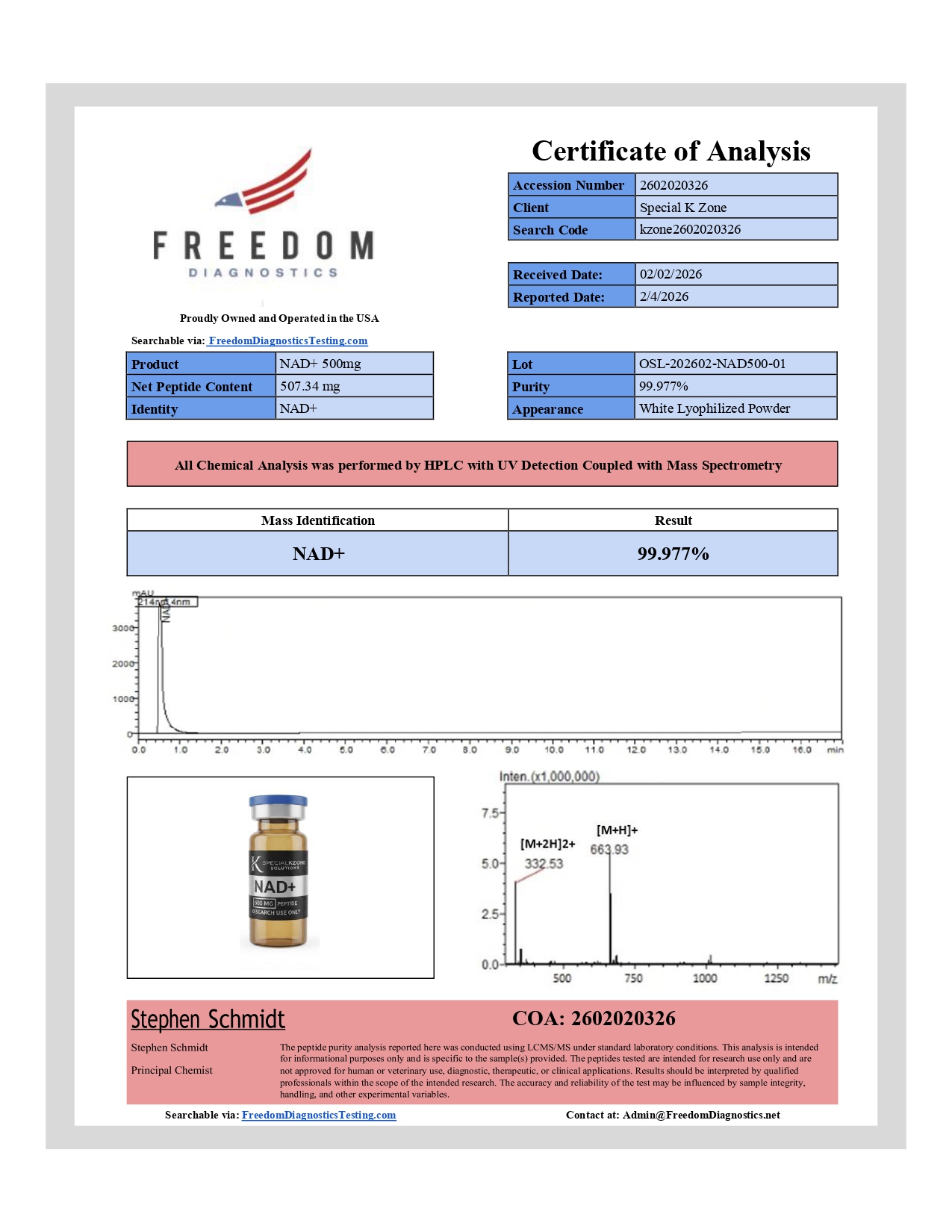
Each batch analyzed for purity via reverse-phase HPLC and identity confirmation through mass spectrometry (expected m/z 664.1 [M+H]+ for NAD+). Contaminant screening for nicotinamide (NAM), nicotinamide mononucleotide (NMN), and NADH ensures minimal degradation products. Activity verified through enzymatic assays measuring lactate dehydrogenase (LDH) or alcohol dehydrogenase (ADH) coupled reactions.
Reconstitution, Handling & Protocol Optimization
Preparation Guidelines:
Reconstitute NAD+ 500mg with 5-10ml of bacteriostatic water or sterile phosphate-buffered saline (PBS) to create a 50-100mg/ml stock solution. Unlike peptide hormones requiring acidic pH for stability, NAD+ demonstrates optimal stability in slightly acidic to neutral solutions (pH 6.0-7.5). Critical: Avoid alkaline conditions (pH >9) where NAD+ rapidly hydrolyzes to nicotinamide and ADP-ribose; similarly, avoid prolonged exposure to strong acids which can cleave the glycosidic bond.
Stability Considerations:
NAD+ is significantly more labile than stable peptides like BPC-157. The molecule is sensitive to:
- Light: UV exposure promotes photodegradation; store solutions in amber vials or wrapped in foil
- Heat: Accelerates hydrolysis; maintain cold chain during transport and storage
- pH Extremes: Optimal stability between pH 6-8; instability increases exponentially above pH 9
- Freeze-Thaw: Minimize cycles; prepare single-use aliquots at -80°C for long-term storage
Research Concentrations:
Cell culture studies typically utilize 0.1-5mM NAD+ in media, depending on the endpoint (sirtuin activation vs. PARP substrate provision). For in-vivo research, doses range from 10-50mg/kg via intraperitoneal or subcutaneous routes, though bioavailability is limited by rapid metabolism; some protocols utilize intranasal or intravenous delivery for enhanced CNS or systemic availability.
Combination Research:
Studies often combine NAD+ with MOTS-c to investigate whether mitochondrial biogenesis signaling (MOTS-c) synergizes with enhanced energy substrate availability (NAD+). Similarly, combination with [BPC-157](#] examines whether improved cellular energy status accelerates tissue healing and regeneration.
Comparative Analysis: NAD+ vs. Alternative Interventions
NAD+ vs. NMN/NR (Precursors):
A major research debate concerns the relative efficacy of direct NAD+ administration versus precursor molecules (Nicotinamide Mononucleotide or Nicotinamide Riboside). Precursors must undergo phosphorylation (NMN) or conversion to NMN then NAD+ (NR) via NMNAT enzymes, steps that may be rate-limiting in aged tissues. Direct NAD+ administration bypasses these enzymatic bottlenecks but faces challenges in cellular uptake (extracellular NAD+ is primarily hydrolyzed by CD38). Research utilizes direct NAD+ to establish physiological effects independent of precursor conversion variables, comparing tissue penetration and bioactivity profiles.
NAD+ vs. MOTS-c:
Both compounds address mitochondrial dysfunction in aging, but through distinct mechanisms. MOTS-c is a mitochondrial-derived peptide that activates AMPK and stimulates mitochondrial biogenesis through transcriptional regulation (PGC-1α). NAD+ serves as the substrate for oxidative phosphorylation and sirtuin-mediated mitochondrial maintenance. Research positions NAD+ as the “fuel” and MOTS-c as the “signal” for mitochondrial health, with combination studies investigating whether signaling without fuel, or fuel without signaling, limits therapeutic efficacy.
NAD+ vs. BPC-157:
While [BPC-157](#] accelerates wound healing and tissue repair through growth factor modulation and angiogenesis, NAD+ supports the energy-intensive processes of cell proliferation and collagen synthesis. Research compares these approaches—structural regeneration factors versus metabolic cofactors—in models of delayed wound healing (diabetes, ischemia), examining whether cellular energy crisis (NAD+ depletion) limits the effectiveness of growth factor administration.
NAD+ vs. Glutathione:
Both are essential for redox homeostasis but serve distinct roles. [Glutathione](#] acts as a direct antioxidant, scavenging reactive oxygen species through its reduced thiol group. NAD+ functions as the electron carrier that ultimately reduces glutathione (via glutathione reductase) and powers the antioxidant enzymes (peroxiredoxins, glutaredoxins) that utilize glutathione. Research suggests NAD+ depletion impairs glutathione recycling, positioning NAD+ as the upstream regulator of antioxidant capacity rather than a direct antioxidant itself.
Safety Considerations & Research Limitations
Methylation Depletion:
Chronic high-dose NAD+ administration (or its degradation product nicotinamide) can consume methyl groups through N-methylation pathways, potentially depleting SAMe (S-adenosylmethionine) and affecting DNA methylation patterns. Research protocols extending beyond 4 weeks should monitor homocysteine levels and consider methyl donor (B-vitamin) supplementation to prevent confounding epigenetic effects.
Flush Reaction:
High-dose NAD+ administration can produce a characteristic “flush”—cutaneous warmth, redness, and mild hypotension—distinct from the histamine-mediated response of [Melanotan 2](#] or niacin. This results from NAD+ hydrolysis to ADP-ribose and activation of TRPM2 channels or purinergic receptors. While generally benign, this side effect requires blinding procedures in behavioral or subjective research studies.
Rapid Clearance:
NAD+ exhibits short plasma half-life due to rapid extracellular hydrolysis by CD38 and uptake by cells. Research must account for this pharmacokinetic profile when designing dosing regimens, potentially requiring continuous infusion or frequent administration to maintain elevated tissue levels.
Frequently Asked Research Questions
How does NAD+ differ from NADH?
This product provides NAD+ (oxidized form), the substrate for sirtuins and PARPs and the electron acceptor in catabolism. NADH is the reduced form (electron donor) primarily involved in ATP synthesis. Research typically utilizes NAD+ to study signaling pathways and redox balance, though both forms interconvert rapidly in biological systems.
Can NAD+ be combined with peptide research?
Yes, NAD+ is often combined with peptides like [MOTS-c](#] or [BPC-157](#] to investigate whether enhanced cellular energy status amplifies growth factor signaling or mitochondrial biogenesis. Ensure compatibility in solution (neutral pH, non-alkaline) when co-administering.
What is the stability of reconstituted NAD+?
Reconstituted NAD+ in bacteriostatic water remains stable for approximately 7 days at 2-8°C when protected from light. For longer storage, freeze aliquots at -80°C and avoid repeated freeze-thaw cycles. Yellow discoloration indicates degradation to nicotinamide and should prompt preparation of fresh solution.
Does NAD+ cross the blood-brain barrier?
The extent of BBB penetration is debated; some research suggests NAD+ is hydrolyzed to NMN or nicotinamide prior to CNS entry, while intranasal administration may bypass BBB constraints. For neuroprotection research, direct CNS delivery or precursor administration may be considered alongside peripheral NAD+ loading.
How does this compare to oral NMN supplements?
Direct NAD+ research establishes biological effects independent of precursor conversion efficiency, which varies by tissue and age. While NMN/NR may offer superior bioavailability for certain applications, NAD+ administration provides immediate substrate availability for sirtuins and PARPs without enzymatic bottlenecks.
NAD is a research compound in lyophilized powder form for laboratory research, testing, and analytical applications.
-
Compound: NAD
-
Quantity: 500 mg
-
Purity: ≥99% (HPLC Certified)
-
Form: Lyophilized powder
-
Appearance: White to off-white powder
-
Solubility: Soluble in laboratory-grade sterile water
-
COA: Included in product image gallery
Reviews
There are no reviews yet.