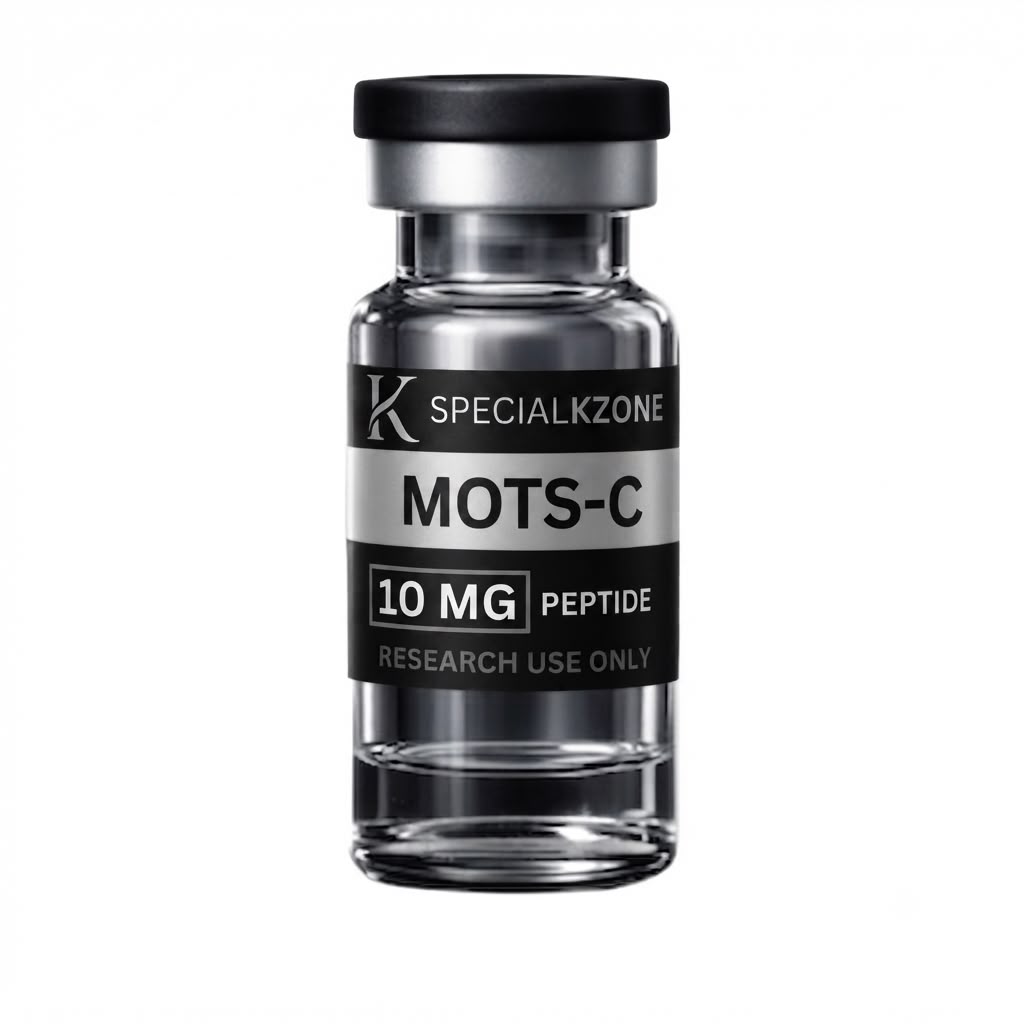
MOTS-c 10mg – Mitochondrial-Derived Peptide for Metabolic & Longevity Research
Our pharmaceutical-grade MOTS-c (Mitochondrial Open Reading Frame of the 12S rRNA-c) represents a paradigm shift in peptide therapeutics, delivering a 16-amino-acid mitochondrial-derived peptide (MDP) that functions as an endocrine signaling molecule between mitochondria and the nucleus. Unlike nuclear-encoded peptides such as BPC-157 or growth hormone secretagogues, MOTS-c is encoded within the mitochondrial genome (mtDNA) and translocates to the nucleus upon cellular stress, where it regulates metabolic homeostasis through transcriptional reprogramming. This 10mg lyophilized preparation provides researchers with a critical tool for investigating mitochondrial-nuclear communication, insulin resistance reversal, and exercise-mimetic adaptations without the receptor desensitization issues associated with traditional endocrine agonists.
Discovered in 2015 by Lee et al., MOTS-c has emerged as a central regulator of metabolic flexibility, enhancing glucose uptake through activation of the folate-purine cycle and upregulating expression of nuclear genes involved in glycolysis and mitochondrial biogenesis. For laboratories studying type 2 diabetes, sarcopenia, or the metabolic derangements of aging, MOTS-c offers a unique mechanism distinct from GLP-1 analogs or insulin sensitizers—it functions as a mitochondrial hormone that restores cellular energy sensing through 5′-adenosine monophosphate-activated protein kinase (AMPK) activation and sirtuin 1 (SIRT1) modulation.
When reconstituted with bacteriostatic water, this research peptide enables investigation into the “mitokine” hypothesis, examining how mitochondrial dysfunction communicates with distal tissues through circulating peptides. Its small size (16 amino acids) confers superior tissue penetration compared to larger proteins, while its endogenous origin minimizes immunogenicity risks in long-term research protocols. Whether studying exercise adaptation, metabolic syndrome, or neurodegenerative models where mitochondrial bioenergetics fail, MOTS-c provides a molecular bridge between organelle function and systemic physiology.
Mitochondrial-Nuclear Signaling & Metabolic Mechanisms
MOTS-c (sequence: MRWQEMGYIFYPRKLR) functions as a retrograde signaling molecule—transmitting information from mitochondria to the nucleus to coordinate cellular adaptation to metabolic stress. Upon cellular stress or exercise, MOTS-c escapes the mitochondrial matrix (potentially via the permeability transition pore or specific transporters) and enters the cytosol, subsequently translocating to the nucleus where it interacts with transcription factors including nuclear factor erythroid 2-related factor 2 (NRF2) and peroxisome proliferator-activated receptor gamma coactivator 1-alpha (PGC-1α).
AMPK Activation & Insulin Sensitivity:
The primary metabolic action involves conversion of 5-methyltetrahydrofolate to methionine via the folate cycle, leading to accumulation of 5-aminoimidazole-4-carboxamide ribonucleotide (AICAR)—a potent AMPK activator. Unlike CJC-1295 No DAC, which influences metabolism through growth hormone axis modulation, MOTS-c enhances insulin sensitivity through direct cellular energy sensing, increasing glucose transporter type 4 (GLUT4) translocation to membranes and upregulating expression of hexokinase II. Research indicates this mechanism can reverse insulin resistance in high-fat diet models independently of weight loss, suggesting direct cellular reprogramming rather than systemic hormonal changes.
Mitochondrial Biogenesis:
Through PGC-1α upregulation, MOTS-c stimulates mitochondrial biogenesis—the creation of new mitochondria to replace damaged organelles. This distinguishes it from BPC-157, which promotes tissue repair through angiogenesis and growth factor recruitment without directly addressing mitochondrial density or function. Research combining MOTS-c with exercise protocols investigates whether the peptide can amplify training adaptations by enhancing the transcriptional response to mechanical loading.
Cellular Stress Resistance:
MOTS-c activates NRF2-mediated antioxidant responses, upregulating superoxide dismutase (SOD), catalase, and glutathione biosynthesis. This endogenous antioxidant induction differs from direct antioxidant administration (such as Glutathione, which can paradoxically blunt adaptive responses. MOTS-c stimulates the cell’s intrinsic defense mechanisms, potentially offering superior protection against oxidative stress in aging and neurodegenerative models.
Research Applications & Therapeutic Models
Type 2 Diabetes & Metabolic Syndrome:
The flagship application for MOTS-c research involves insulin resistance and glucose intolerance. Studies demonstrate that MOTS-c administration normalizes glucose tolerance in obese mice, improves lipid profiles by reducing hepatic steatosis, and prevents the metabolic inflexibility characteristic of aging. Research protocols examine whether MOTS-c can function as an “exercise pill”—mimicking the metabolic benefits of physical activity in sedentary or disabled research models.
Sarcopenia & Muscle Aging:
As mitochondria decline in number and function with age (mitochondrial theory of aging), MOTS-c research investigates whether restoration of mitochondrial-nuclear signaling can preserve muscle mass and contractile function. Studies focus on preventing age-related muscle atrophy through enhanced mitochondrial biogenesis and improved oxidative capacity in type II muscle fibers, distinct from the growth factor approach of [IGF-1 LR3](https://specialkzone.com/product/igf1-lr3/) or the inflammatory modulation of [KPV](https://specialkzone.com/product/kpv/).
Neurodegenerative Disease Models:
Mitochondrial dysfunction characterizes Alzheimer’s, Parkinson’s, and Huntington’s diseases. MOTS-c crosses the blood-brain barrier to enhance neuronal mitochondrial function, reduce amyloid-beta toxicity, and improve synaptic plasticity. Research examines whether MOTS-c can prevent cognitive decline by maintaining cerebral energy metabolism, offering a metabolic approach distinct from amyloid-targeting therapies.
Exercise Physiology & Performance:
MOTS-c levels rise dramatically with exercise, suggesting it mediates many training adaptations. Research utilizes the peptide to investigate “exercise mimetics”—pharmacological agents that produce physical training benefits without actual activity. Studies measure VO2 max improvements, lactate threshold enhancement, and recovery acceleration in sedentary models administered MOTS-c, comparing outcomes to actual exercise regimens.
Longevity & Aging Research:
Caloric restriction extends lifespan through metabolic reprogramming involving sirtuins and AMPK. MOTS-c research investigates whether this peptide serves as a downstream effector of caloric restriction, potentially offering the longevity benefits of dietary restriction without nutritional deprivation. Studies examine lifespan extension in aging models, inflammation reduction (inflammaging), and maintenance of stem cell function.
Product Specifications & Molecular Characteristics
- Chemical Name: MOTS-c; Mitochondrial Open Reading Frame of the 12S rRNA-c
- Sequence: MRWQEMGYIFYPRKLR (single letter code)
- Full Sequence: Met-Arg-Trp-Gln-Glu-Met-Gly-Tyr-Ile-Phe-Tyr-Pro-Arg-Lys-Leu-Arg
- Molecular Formula: C₁₀₁H₁₅₅N₂₉O₂₂S₂
- Molecular Weight: ~2,174 Da (varies by counter-ion)
- Origin: Mitochondrial DNA-encoded (mtDNA)
- Total Content: 10mg per vial (lyophilized powder)
- Structure: Linear 16-amino-acid peptide
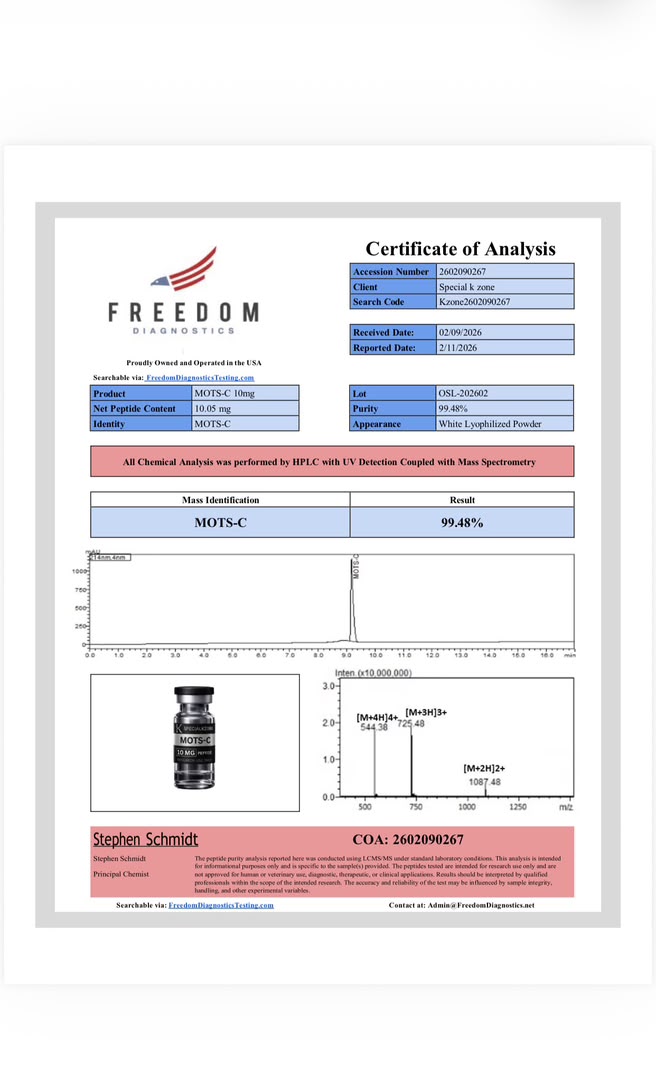
- Purity: ≥98% (HPLC verified)
- Appearance: White to off-white lyophilized powder
- Solubility: Soluble in aqueous solutions, optimal in sterile water or PBS
- Storage: -20°C stable (lyophilized), -80°C for long-term (>6 months)
- Reconstituted Stability: 7-14 days at 2-8°C when prepared with appropriate preservatives
Quality Verification:
Each batch verified via mass spectrometry for correct molecular weight and sequence confirmation. Unlike nuclear-encoded peptides, MOTS-c contains methionine and cysteine residues (though sequence shows Met but no Cys in standard MOTS-c), requiring verification of oxidation status. Biological activity confirmed via AMPK phosphorylation assays in C2C12 myoblasts or glucose uptake assays in adipocytes.
Reconstitution, Handling & Administration Protocols
Preparation Guidelines:
Reconstitute MOTS-c 10mg with 2-5ml of bacteriostatic water to create a 2-5mg/ml stock solution. As a small peptide without complex disulfide bonds (unlike IGF-1 LR3, MOTS-c demonstrates straightforward solubility in neutral aqueous buffers. Gentle agitation suffices for complete dissolution.
Research Dosing Parameters:
Typical research concentrations range from 5-15 mg/kg body weight in rodent models, administered via intraperitoneal or subcutaneous injection. Due to its short plasma half-life (estimated 5-10 minutes), research protocols often utilize multiple daily administrations or continuous infusion pumps to maintain therapeutic levels. Some research suggests intranasal administration for enhanced CNS delivery in neurodegenerative studies.
Timing Considerations:
For metabolic research, MOTS-c is often administered prior to glucose tolerance testing (GTT) to assess acute insulin-sensitizing effects, or chronically (daily for 4-8 weeks) to evaluate body composition changes and mitochondrial density adaptations.
Combination Research:
Studies frequently combine MOTS-c with exercise training to examine synergistic effects on mitochondrial biogenesis. Unlike [CJC-1295 No DAC](#], which requires careful timing around food intake due to GH-mediated effects on glucose, MOTS-c can be administered independently of nutritional status, though some protocols align administration with fasting periods to mimic exercise-induced mitokine release.
H2: Comparative Analysis: MOTS-c vs. Alternative Compounds
MOTS-c vs. BPC-157:
While BPC-157 accelerates tissue healing through angiogenesis, growth factor modulation, and extracellular matrix remodeling, MOTS-c operates at the metabolic level—enhancing cellular energy production and insulin sensitivity. BPC-157 repairs structural damage; MOTS-c prevents cellular energy crisis. Combination research investigates whether improved metabolic function (MOTS-c) accelerates the structural repair processes initiated by BPC-157, particularly in diabetic wound healing where mitochondrial dysfunction impairs fibroblast function.
MOTS-c vs. CJC-1295/Ipamorelin:
[CJC-1295 No DAC](#] and growth hormone secretagogues influence metabolism through the somatotropic axis, increasing lipolysis and lean mass via IGF-1. MOTS-c influences metabolism through direct cellular energy sensing (AMPK) and mitochondrial biogenesis, independent of GH status. Research comparing these approaches examines whether mitochondrial health (MOTS-c) or anabolic hormone status (GH/IGF-1) predominates in metabolic syndrome reversal, with combination protocols potentially offering complementary benefits.
MOTS-c vs. GHK-Cu:
[GHK-Cu](#] (Copper Peptide) influences tissue repair through copper ion delivery and gene expression changes related to extracellular matrix. MOTS-c influences tissue function through mitochondrial biogenesis and metabolic reprogramming. Both affect aging, but GHK-Cu focuses on structural maintenance while MOTS-c focuses on bioenergetic capacity. Research into “healthy aging” often combines both to address structural and functional deterioration simultaneously.
Stability Considerations & Research Limitations
Oxidation Sensitivity:
MOTS-c contains methionine residues susceptible to oxidation to methionine sulfoxide, potentially reducing biological activity. Storage at -20°C or -80°C in lyophilized form prevents this degradation. Reconstituted solutions should be used within 7-14 days and protected from light and oxygen exposure.
Rapid Clearance:
The small size of MOTS-c (16 amino acids) facilitates tissue penetration but also rapid renal clearance. Research protocols must account for short half-life when designing dosing regimens, potentially requiring continuous infusion or frequent injections for sustained metabolic effects.
Species Specificity:
Mitochondrial DNA varies between species, and while the MOTS-c sequence is highly conserved, researchers should verify activity in their specific model organisms, as slight sequence variations may affect receptor binding or translocation efficiency.
Frequently Asked Research Questions
What makes MOTS-c different from other metabolic peptides?
MOTS-c is unique as a mitochondrial-encoded peptide (mtDNA) rather than nuclear DNA. It functions as a mitokine—signaling mitochondrial status to the nucleus and distal tissues—unlike [Glutathione](#], which is a cellular antioxidant, or insulin sensitizers that target membrane receptors.
Can MOTS-c replace exercise in research models?
Research indicates MOTS-c produces many metabolic adaptations similar to exercise (improved glucose tolerance, mitochondrial biogenesis) but does not replicate mechanical loading effects on bone and muscle contractile proteins. It functions best as an “exercise enhancer” or “exercise mimetic” for metabolic parameters rather than a complete replacement.
How does this compare to NAD+ precursors for longevity?
Both MOTS-c and NAD+ boosters (NMN, NR) target sirtuins and mitochondrial function, but MOTS-c specifically activates the folate-purine-AMPK axis and directly stimulates mitochondrial biogenesis through PGC-1α. Research compares these pathways for synergistic versus redundant effects in aging models.
Is MOTS-c stable for oral administration research?
Due to its small size (16 amino acids), MOTS-c shows better oral bioavailability than larger peptides, though degradation by gastric acids and peptidases remains significant. Oral administration research typically employs enteric coatings or co-administration with absorption enhancers.
Does MOTS-c affect thyroid function?
Unlike [CJC-1295](#] which can influence thyroid axis through GH interactions, MOTS-c research indicates direct metabolic effects without significant thyroid hormone modulation, though indirect effects on metabolic rate may occur through mitochondrial efficiency improvements.
MOTS-C is a research compound in lyophilized powder form for laboratory research, testing, and analytical applications.
-
Compound: MOTS-C
-
Quantity: 10 mg
-
Purity: ≥99% (HPLC Certified)
-
Form: Lyophilized powder
-
Appearance: White to off-white powder
-
Solubility: Soluble in laboratory-grade sterile water
-
COA: Included in product image gallery
Reviews
There are no reviews yet.