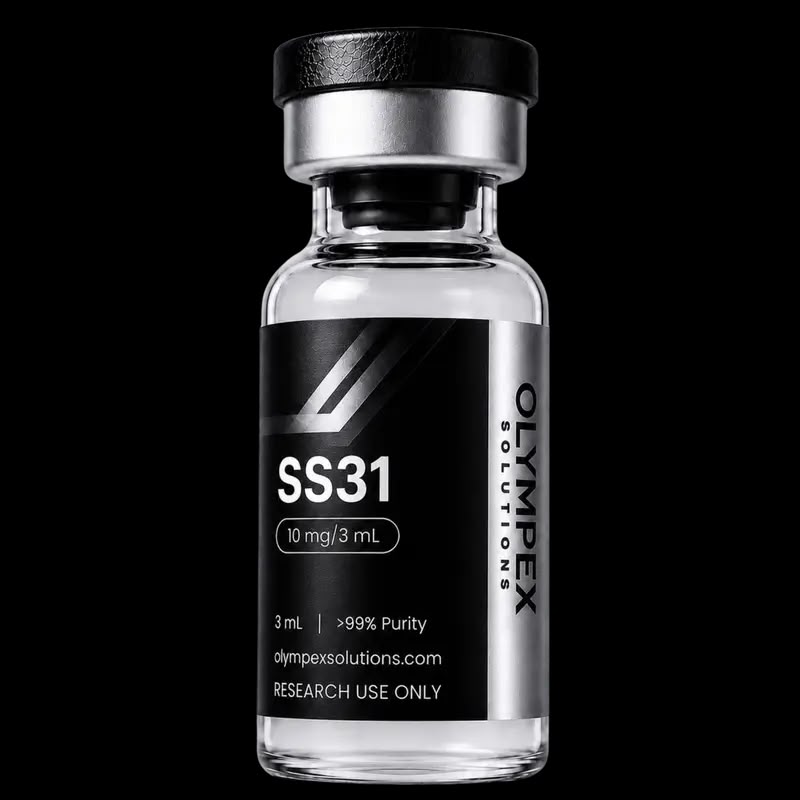
SS31 10mg – Mitochondrial-Targeted Peptide for Bioenergetics & Cellular Protection Research
Our pharmaceutical-grade SS-31 (also known as Bendavia or MTP-131) represents a breakthrough in mitochondrial medicine, delivering a cell-permeable, mitochondrial-targeted peptide specifically engineered to concentrate within the inner mitochondrial membrane and protect cardiolipin integrity. Unlike systemic antioxidants such as [Glutathione](https://specialkzone.com/product/glutathione/) or metabolic substrates like [NAD+](https://specialkzone.com/product/nad/), which distribute throughout the cellular aqueous compartments, SS-31 possesses a unique aromatic-cationic tetrapeptide structure (D-Arg-2,6-dimethylTyr-Lys-Phe-NH₂) that exploits the large negative membrane potential of mitochondria (-150 to -180 mV) to accumulate 1,000-5,000 fold within the mitochondrial matrix compared to cytosol. This targeted delivery allows SS-31 to scavenge reactive oxygen species (ROS) at their source—preventing cardiolipin peroxidation and cristae damage that precede apoptosis and necrosis—while sparing extra-mitochondial redox signaling essential for cellular homeostasis.
Developed by Hazel Szeto and Peter Schiller as a prototype Szeto-Schiller (SS) peptide, SS-31 binds specifically to cardiolipin, a dimeric phospholipid exclusive to the inner mitochondrial membrane that stabilizes respiratory chain supercomplexes and maintains the structural integrity of ATP synthase. Research indicates that SS-31 not only prevents oxidative damage to cardiolipin but actively promotes cristae remodeling and mitochondrial biogenesis, distinguishing it from [MOTS-c](#], which stimulates mitochondrial biogenesis through transcriptional signaling (PGC-1α), and [BPC-157](#], which promotes tissue healing through angiogenesis and growth factor modulation. When reconstituted with [bacteriostatic water](#], this 10mg preparation enables investigation into the “mitochondrial medicine” paradigm—addressing bioenergetic failure as a root cause of ischemia-reperfusion injury, heart failure, neurodegeneration, and accelerated aging, rather than merely treating downstream symptoms of these pathologies.
For laboratories studying cellular bioenergetics, ischemic tolerance, or the mitochondrial theory of aging, SS-31 provides a tool to dissociate the protective effects of targeted mitochondrial antioxidant delivery from the pleiotropic consequences of systemic redox modulation, offering insights into whether preserving mitochondrial architecture can prevent programmed cell death independent of nuclear transcriptional changes.
H2: Mitochondrial Targeting & Cardiolipin Protection Mechanisms
SS-31 (molecular weight ~640 Da) belongs to the Szeto-Schiller class of aromatic-cationic peptides characterized by alternating aromatic and basic amino acid residues that facilitate passage through plasma membranes and mitochondrial accumulation. The dimethyltyrosine residues provide antioxidant radical-scavenging capacity, while the positive charge drives electrophoretic migration into the negatively charged mitochondrial matrix.
Cardiolipin Stabilization:
Cardiolipin constitutes approximately 20% of the inner mitochondrial membrane lipid content and is essential for organizing respiratory chain complexes (I, III, IV) into functional supercomplexes that optimize electron transport chain efficiency. During oxidative stress, cardiolipin undergoes peroxidation, causing supercomplex disassembly, cytochrome c release, and initiation of the intrinsic apoptotic pathway. SS-31 binds to cardiolipin through both hydrophobic and electrostatic interactions, shielding the unsaturated fatty acid chains from ROS attack and preventing the peroxidation cascade that compromises membrane fluidity and protein function.
Cristae Architecture Preservation:
Beyond lipid protection, SS-31 maintains the structural folds of mitochondrial cristae—the invaginations of the inner membrane that house ATP synthase and respiratory chain complexes. Electron microscopy studies demonstrate that SS-31 prevents pathological cristae remodeling and fragmentation during ischemia-reperfusion injury, preserving the surface area necessary for oxidative phosphorylation and preventing the release of pro-apoptotic factors (cytochrome c, SMAC/Diablo) into the cytosol.
Targeted vs. Systemic Antioxidation:
Unlike [Glutathione](https://specialkzone.com/product/glutathione/), which scavenges ROS throughout the cell but cannot penetrate the mitochondrial membrane efficiently, or vitamin E analogs that distribute indiscriminately in lipid bilayers, SS-31 concentrates specifically at the site of maximum ROS production (Complexes I and III). This targeting prevents the “redox buffering” of signaling ROS in the cytosol and nucleus, preserving physiological redox signaling while neutralizing pathological mitochondrial oxidative stress—a pharmacological precision impossible with untargeted antioxidants.
Research Applications & Therapeutic Models
Ischemia-Reperfusion Injury:
The primary application for SS-31 research involves myocardial infarction, stroke, and organ transplantation models, where restoration of blood flow paradoxically exacerbates tissue damage through mitochondrial ROS burst and calcium overload. SS-31 administration immediately prior to reperfusion preserves mitochondrial membrane potential, prevents calcium-induced opening of the permeability transition pore (mPTP), and reduces infarct size by 40-60% in preclinical models—superior to general antioxidants and comparable to ischemic preconditioning protocols. Research investigates optimal timing (pre-ischemia vs. at reperfusion) and dosing strategies for clinical translation.
Heart Failure & Cardiomyopathy:
Chronic heart failure involves progressive mitochondrial dysfunction, ATP depletion, and accumulation of damaged mitochondria. SS-31 research demonstrates restoration of cardiac contractility in pressure-overload and doxorubicin-induced cardiomyopathy models, not merely through antioxidant effects but through preservation of mitochondrial quality control mechanisms. Studies examine whether SS-31 can reverse established mitochondrial dysfunction or only prevent acute injury, distinguishing it from metabolic modulators like [MOTS-c](#].
Neurodegenerative Diseases:
For Alzheimer’s and Parkinson’s research, SS-31 addresses the mitochondrial dysfunction that precedes neuronal loss—amyloid-beta and alpha-synuclein both induce mitochondrial fragmentation and cardiolipin oxidation. Research indicates SS31 prevents cognitive decline in amyloid precursor protein (APP) transgenic models and preserves dopaminergic neurons in MPTP Parkinson’s models, potentially more effectively than mitochondrial biogenesis stimulators by protecting existing mitochondria rather than generating new ones. This neuroprotection contrasts with [BPC-157](#]’s angiogenic and growth factor-mediated repair mechanisms.
Metabolic Syndrome & Aging:
Aging (” inflammaging”) involves cumulative mitochondrial DNA damage and respiratory chain decline. SS31 research investigates whether targeted mitochondrial protection can improve insulin sensitivity (by preserving beta-cell mitochondrial function), reduce skeletal muscle fatigue (by maintaining ATP production), and extend healthspan by preventing the cellular senescence driven by mitochondrial dysfunction. Unlike [NAD+](https://specialkzone.com/product/nad/), which provides substrate for energy production but does not protect against oxidative damage, SS-31 preserves the structural capacity for energy generation.
Acute Kidney Injury & Sepsis:
Ischemic acute kidney injury and septic shock involve mitochondrial fragmentation and bioenergetic failure in renal tubular cells. SS-31 demonstrates renoprotection in cisplatin and ischemia models, preserving glomerular filtration rate and reducing tubular apoptosis through mitochondrial membrane stabilization.
Product Specifications & Molecular Characteristics
- Chemical Name: SS-31; Bendavia; MTP-131; D-Arg-2,6-dimethylTyr-Lys-Phe-NH₂
- Class: Szeto-Schiller (SS) peptide; aromatic-cationic tetrapeptide
- Sequence: D-Arginyl-2,6-dimethyltyrosyl-lysyl-phenylalaninamide
- Molecular Formula: C₃₂H₄₉N₉O₅ (varies by salt form)
- Molecular Weight: ~639.8 g/mol (free base)
- Total Content: 10mg per vial (lyophilized powder, typically acetate or trifluoroacetate salt)
- Structure: Linear tetrapeptide with dimethylated tyrosine residues
- Targeting Mechanism: Cationic charge drives mitochondrial accumulation via membrane potential
- Purity: ≥98% (HPLC verified)
- Appearance: White to off-white lyophilized powder
- Solubility: Soluble in water, DMSO, and aqueous buffers
- Storage: -20°C stable (lyophilized), protect from light and moisture
- Reconstituted Stability: 7-14 days at 2-8°C when prepared with sterile preservatives
Quality Verification:
Each batch analyzed via mass spectrometry for correct molecular weight (640.4 [M+H]+ expected) and verification of dimethyltyrosine modification (critical for antioxidant activity). Purity confirmed through reverse-phase HPLC. Mitochondrial targeting verified through cell-based accumulation assays using isolated mitochondria or fluorescent tracking in neuronal/cardiac cell lines.
Reconstitution, Handling & Research Protocols
Preparation Guidelines:
Reconstitute SS-31 10mg with 1-2ml of [bacteriostatic water](#] to create a 5-10mg/ml stock solution. The peptide demonstrates excellent aqueous solubility due to its cationic nature. For cell culture applications, dilute further in serum-free medium to prevent binding to serum proteins that may reduce free peptide availability. For in-vivo studies, sterile saline or PBS may be used; the peptide demonstrates stability in physiological buffers but should be protected from light to prevent photodegradation of the dimethyltyrosine residues.
Administration Routes:
Research employs multiple routes depending on target tissue:
- Intravenous/Intraperitoneal: For rapid systemic distribution to heart, brain, and kidneys; optimal for acute ischemia-reperfusion studies.
- Subcutaneous: For sustained plasma levels in chronic administration protocols (aging, metabolic syndrome).
- Intranasal: Under investigation for enhanced CNS delivery in neurodegenerative models, though less established than for smaller peptides.
Dosing Parameters:
Typical research concentrations range from 1-5 mg/kg body weight in rodent models for acute protection, and 0.5-2 mg/kg for chronic daily administration in aging or cardiomyopathy studies. The therapeutic window is generally wide due to the peptide’s rapid renal clearance and specific mitochondrial accumulation in target tissues rather than systemic retention.
Timing Considerations:
For ischemia-reperfusion research, SS31 demonstrates efficacy when administered 15-30 minutes prior to reperfusion (pre-conditioning) or immediately at reperfusion onset. For chronic disease models, twice-daily administration maintains mitochondrial protection throughout the circadian cycle.
Comparative Analysis: SS-31 vs. Alternative Mitochondrial Interventions
SS-31 vs. MOTS-c:
While both address mitochondrial health, [MOTS-c](#] is a mitochondrial-derived signaling peptide (MDP) that activates AMPK and stimulates mitochondrial biogenesis through nuclear transcriptional programs (PGC-1α). SS-31 directly targets existing mitochondria, preserving their structural integrity and function without necessarily increasing mitochondrial number. Research compares whether generating new mitochondria (MOTS-c) or protecting existing ones (SS-31) proves more effective in acute versus chronic disease models, with combination protocols investigating potential synergy.
SS-31 vs. BPC-157:
[BPC-157](#] promotes tissue healing through angiogenesis, growth factor upregulation (VEGF), and extracellular matrix remodeling—essentially rebuilding damaged structures. SS-31 prevents cellular death by preserving the energy-generating capacity of mitochondria during stress. In ischemic injury research, BPC-157 may promote long-term vascular remodeling while SS-31 provides acute cytoprotection; combination studies investigate whether vascular patency without cellular bioenergetics (or vice versa) is sufficient for tissue salvage.
SS-31 vs. NAD+:
[NAD+](https://specialkzone.com/product/nad/) serves as the essential substrate for oxidative phosphorylation and sirtuin activity, providing the “fuel” and “signaling molecules” for mitochondrial function but offering no direct protection against ROS-mediated damage. SS31 protects the physical machinery (cardiolipin, cristae) that utilizes NAD+. Research investigates whether NAD+ supplementation without structural protection (or protection without substrate provision) limits therapeutic efficacy in models of mitochondrial dysfunction.
SS-31 vs. General Antioxidants (Vitamin E, NAC):
Untargeted antioxidants distribute throughout cellular and extracellular compartments, potentially disrupting physiological redox signaling required for insulin sensitivity, immune function, and hypoxic adaptation. SS31‘s mitochondrial specificity preserves these extra-mitochondrial redox processes while neutralizing the pathological ROS burst at the respiratory chain—a pharmacological precision that explains its superior efficacy in ischemia models despite lower “total antioxidant capacity” compared to high-dose vitamin E.
Safety Considerations & Research Limitations
Rapid Clearance:
SS-31 demonstrates rapid renal elimination due to its small size and positive charge, requiring repeated dosing for chronic protection rather than single-dose long-term coverage. This pharmacokinetic profile is advantageous for acute toxicity studies (rapid clearance if adverse effects occur) but necessitates dosing schedules for chronic disease research.
Mitochondrial Specificity vs. Off-Target Effects:
While designed for mitochondrial targeting, high concentrations may accumulate in other negatively charged membranes (bacterial membranes, certain plasma membrane domains). Research should monitor for non-specific effects at suprapharmacological doses.
Species Translation:
Mitochondrial membrane potential and cardiolipin composition vary slightly between species; efficacy in rodent models requires verification in larger animal models prior to clinical extrapolation.
Frequently Asked Research Questions
What makes SS-31 different from other antioxidants?
SS-31 accumulates specifically in mitochondria (1,000-5,000x concentration) due to the membrane potential, targeting cardiolipin exclusively. General antioxidants like [Glutathione](https://specialkzone.com/product/glutathione/) or vitamin E distribute throughout the cell and cannot penetrate the inner mitochondrial membrane efficiently at therapeutic concentrations.
Does SS-31 increase mitochondrial biogenesis?
While primarily protective, SS-31 indirectly promotes mitochondrial health by preventing damage that triggers mitophagy and may support biogenesis signaling through preserved ATP levels and reduced oxidative damage to mitochondrial DNA. However, direct biogenesis stimulation is better achieved with [MOTS-c](#] or PGC-1α activators.
Can SS-31 cross the blood-brain barrier?
Yes, the aromatic-cationic structure facilitates BBB penetration, allowing SS-31 to accumulate in neuronal mitochondria. Intranasal administration is under investigation for enhanced CNS delivery, though IV/IP routes achieve significant brain mitochondrial targeting.
Is it stable in solution?
SS-31 demonstrates good aqueous stability but should be protected from light (due to dimethyltyrosine photosensitivity) and used within 7-14 days when reconstituted. Lyophilized powder is stable for 12-24 months at -20°C.
How does it compare to MitoQ or SkQ1?
These are targeted antioxidants (ubiquinone/plastoquinone derivatives) that also accumulate in mitochondria but localize to the inner membrane periphery. SS-31 specifically binds cardiolipin and preserves cristae structure, offering structural protection beyond mere ROS scavenging.
Reviews
There are no reviews yet.