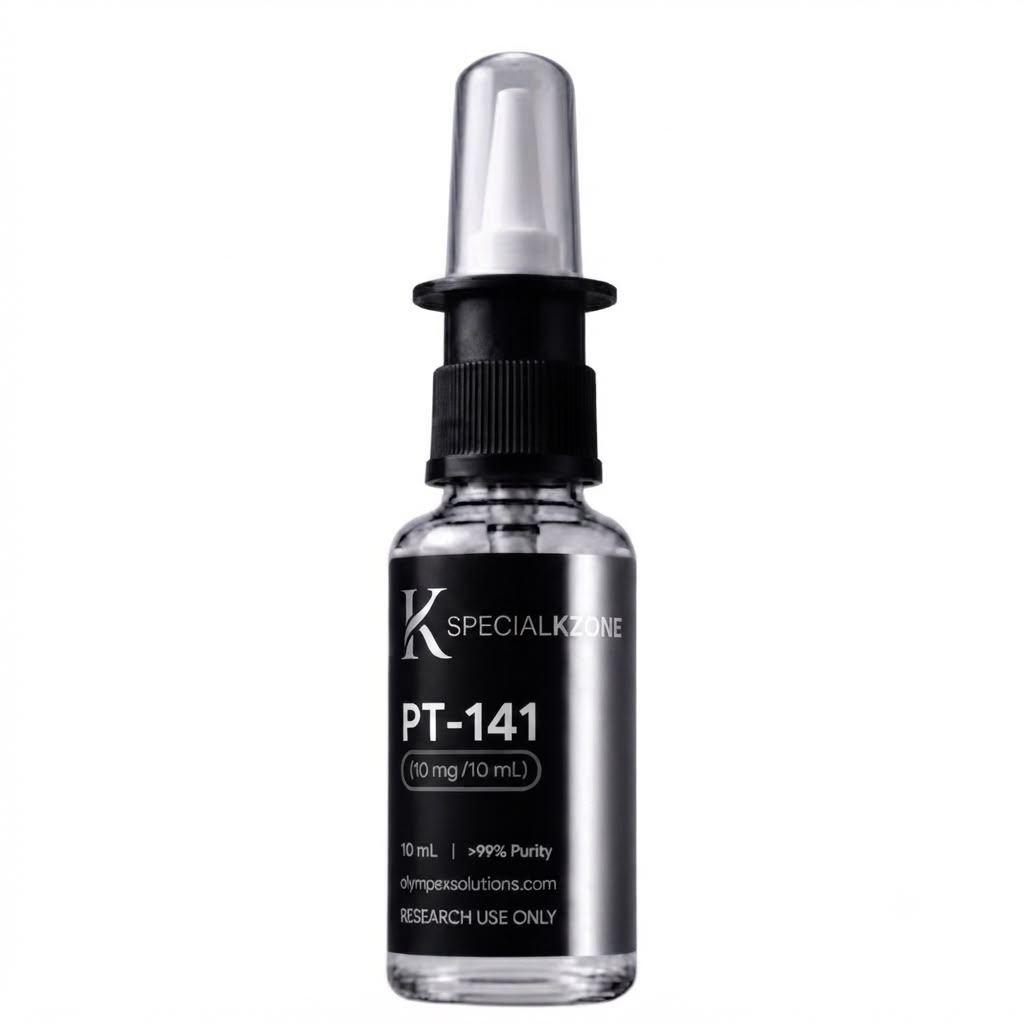
PT-141 Spray – Intranasal Bremelanotide for Rapid Central Arousal Research
Our pharmaceutical-grade PT-141 Spray delivers Bremelanotide through an advanced intranasal formulation optimized for rapid central nervous system penetration and immediate onset of pro-sexual effects. While subcutaneous PT-141 (Bremelanotide) requires 30-60 minutes for systemic absorption and blood-brain barrier transit, this metered-dose nasal spray exploits the olfactory and trigeminal nerve pathways to achieve hypothalamic MC4R activation within 10-20 minutes of administration. This pharmacokinetic profile revolutionizes sexual dysfunction research by enabling precise temporal control over sexual arousal paradigms, allowing investigators to synchronize melanocortin activation with behavioral testing, psychophysiological measurement, or functional neuroimaging without the injection trauma and variable absorption kinetics associated with parenteral delivery.
The PT-141 Spray format addresses critical methodological limitations in sexual psychophysiology research. Traditional injectable routes introduce stress responses (cortisol elevation, sympathetic activation from needle phobia) that confound sexual arousal data, while oral administration faces complete degradation by gastric acids and hepatic first-pass metabolism. By delivering Bremelanotide directly to the nasal mucosa—where it bypasses the BBB via axonal transport along olfactory neurons—researchers achieve “clean” central arousal with minimized peripheral side effects, particularly the nausea and blood pressure changes that often complicate subcutaneous dosing protocols. This non-invasive approach proves particularly valuable for chronic dosing studies investigating long-term sexual function restoration, where injection site reactions or compliance barriers might limit research duration.
For behavioral pharmacology laboratories investigating the immediate neural correlates of sexual desire, the PT-141 Spray provides a tool for acute arousal induction that parallels the rapid onset of intranasal [DSIP Spray](https://specialkzone.com/product/dsip-spray/) for sleep induction—creating a methodological symmetry where researchers can investigate circadian regulation of sexual function by administering arousal-promoting melanocortins during waking hours and sleep-promoting peptides during rest periods, all through the same non-invasive delivery platform.
Nose-to-Brain Mechanisms & Rapid CNS Penetration
The PT-141 Spray leverages the unique neuroanatomy of the nasal cavity to achieve CNS concentrations impossible through systemic administration. The olfactory epithelium contains bipolar neurons that project axons directly through the cribriform plate into the olfactory bulb, creating a direct conduit from the external environment to the brain that bypasses the restrictive blood-brain barrier entirely. When Bremelanotide is deposited on this specialized mucosa, it undergoes receptor-mediated or passive transcytosis into olfactory sensory neurons, followed by rapid axonal transport to the olfactory bulb and subsequent distribution to limbic structures including the medial preoptic area (MPOA) and nucleus accumbens—critical nodes for sexual motivation and reward.
Trigeminal Pathway Synergism:
Beyond the olfactory route, the trigeminal nerve innervating the respiratory mucosa provides parallel access to the brainstem and hypothalamus. This dual innervation ensures that PT-141 reaches both the forebrain reward circuitry and the hypothalamic-pituitary axis rapidly, activating the mesolimbic dopaminergic pathways responsible for sexual desire while simultaneously stimulating sympathetic outflow for physiological arousal. Research indicates that intranasal melanocortins can achieve CSF concentrations 5-10 times higher than equivalent subcutaneous doses, with peak levels occurring within 15 minutes versus 60-90 minutes for injection.
Reduced Peripheral Exposure:
By entering the brain before dilution into systemic circulation, the PT-141 Spray format minimizes exposure to peripheral MC4R populations in the area postrema (medullary vomiting center) and vascular smooth muscle. This altered biodistribution potentially reduces the nausea and hypertension side effects that limit dosing in injectable protocols, allowing researchers to investigate higher central doses for enhanced sexual arousal endpoints without the limiting autonomic side effects observed with subcutaneous administration.
Comparison to Subcutaneous PT-141:
While the PT-141 injectable format provides sustained 4-6 hour duration suitable for chronic sexual dysfunction protocols, the PT-141 Spray offers a shorter acting (2-3 hour) but faster onset profile ideal for acute arousal research, episodic sexual dysfunction investigation, or studies requiring multiple daily assessments of sexual function.
Research Applications & Methodological Advantages
Acute Sexual Arousal Paradigms:
The primary research application for PT-141 Spray involves psychophysiological studies requiring immediate sexual arousal induction. The 10-20 minute onset allows researchers to pair melanocortin administration with specific erotic stimuli, functional MRI scanning, or vaginal photoplethysmography/penile tumescence measurement with precise temporal alignment. This proves impossible with injectable formats where absorption variability creates 30-90 minute onset windows, confounding stimulus-response timing.
Female Sexual Interest/Arousal Disorder (FSIAD):
For research into FSIAD and hypoactive sexual desire disorder, the PT-141 Spray enables “as-needed” dosing protocols that mimic real-world sexual encounter spontaneity. Unlike chronic daily dosing regimens, intranasal administration allows participants to self-administer immediately prior to anticipated sexual activity, assessing whether rapid central arousal induction overcomes the anticipatory anxiety and avoidance behaviors characteristic of FSIAD.
Psychogenic Erectile Dysfunction:
Research into performance anxiety and psychogenic ED benefits from the non-invasive nature of nasal delivery, eliminating injection-related stress that might exacerbate psychological barriers to arousal. The rapid onset allows investigation into whether immediate central dopaminergic activation can override sympathetic inhibition of erectile function in anxiety models, distinct from the peripheral vasodilation mechanisms of PDE5 inhibitors.
Addiction & Reward Circuitry:
The PT-141 Spray serves as a probe for investigating the mesolimbic reward system independent of drug rewards. By rapidly activating the nucleus accumbens through MC4R stimulation, researchers can compare “natural” sexual reward processing to drug-induced dopamine release, potentially identifying mechanisms to restore reward sensitivity in addiction models where natural rewards become salient. This application contrasts with [MT-2 Spray](#], which combines sexual arousal with tanning effects and metabolic activation, confounding pure reward circuitry research.
Product Specifications & Formulation Stability
- Active Compound: Bremelanotide (PT-141); Ac-Nle-cyclo[Asp-His-D-Phe-Arg-Trp-Lys]-OH
- Delivery System: Metered-dose nasal spray pump
- Total Content: Typically 10-20mg total Bremelanotide per bottle
- Concentration: Approximately 1-2mg/ml aqueous solution
- Dosing per Actuation: ~100mcg per spray (100-200 actuations per bottle)
- Formulation: Isotonic saline with pH buffering (pH 6.0-7.0)
- Preservatives: Benzalkonium chloride or phenylmercuric nitrate (antimicrobial)
- Osmolarity: 280-320 mOsm/kg (physiological for mucosal tolerance)
- Stability: 30 days refrigerated at 2-8°C after opening; do not freeze
- Storage: 2-8°C (refrigerated), protect from light
Quality Control:
Each batch tested for sterility, endotoxin levels (<0.5 EU/ml), and peptide content via HPLC. The aqueous stability of Bremelanotide in nasal formulations is enhanced by the C-terminal free acid modification (vs. amide in Melanotan 2, though refrigeration remains essential to prevent hydrolysis of the cyclic lactam bridge and oxidation of the tryptophan residue.
Administration Protocols & Research Methodologies
Standardized Intranasal Technique:
For reproducible CNS delivery, instruct research subjects to: (1) Clear nasal passages; (2) Shake bottle gently; (3) Tilt head slightly forward (prevents posterior pharyngeal drip); (4) Insert nozzle 1cm into nostril, aiming toward the superior turbinate (olfactory region); (5) Actuate while sniffing gently (not forcefully, to maximize mucosal contact vs. lung deposition); (6) Hold breath for 10 seconds; (7) Avoid blowing nose for 15 minutes post-administration.
Dosing Frequency:
Due to the rapid absorption and shorter duration (2-3 hours vs. 4-6 hours for injectable), research protocols may employ 2-3 sprays per nostril (200-600mcg total) with the ability to redose every 4-6 hours for extended research sessions. This titratability proves advantageous for dose-response studies investigating the threshold for sexual arousal versus side effects.
Timing Considerations:
Onset of subjective arousal typically occurs within 10-20 minutes, with peak effects at 30-60 minutes. Researchers should time stimulus presentation or partner interaction protocols to coincide with this peak window. The shorter duration compared to PT-141 injectable allows for multiple baseline/assessment cycles within a single research day.
Combination with Other Nasal Peptides:
Studies investigating the interaction between sleep, stress, and sexual function may combine PT-141 Spray (morning/afternoon) with [DSIP Spray](https://specialkzone.com/product/dsip-spray/) (evening), utilizing the same delivery route for complementary CNS effects. However, concurrent administration should be avoided to prevent mucosal saturation and ensure adequate absorption of each compound.
Comparative Analysis: PT-141 Spray vs. Alternative Formats
PT-141 Spray vs. Injectable PT-141:
The subcutaneous [PT-141](#] format provides sustained plasma levels suitable for chronic sexual dysfunction protocols with once-daily dosing. The PT-141 Spray offers episodic, rapid-onset arousal ideal for “as-needed” research paradigms. Bioavailability differs significantly: injectable routes achieve ~100% systemic exposure with gradual CNS penetration, while intranasal delivers lower total systemic doses but higher initial CNS concentrations through direct nerve transport.
PT-141 Spray vs. MT-2 Spray:
While [MT-2 Spray](#] (Melanotan II nasal) produces sexual arousal alongside melanogenesis and metabolic activation, PT-141 Spray isolates the pro-sexual effects through enhanced MC4R selectivity. Research comparing these sprays investigates whether the tanning and appetite effects of MT-2 confound sexual behavior data, and whether the “cleaner” profile of PT-141 offers superior dose tolerability for pure sexual dysfunction research without pigmentary side effects.
PT-141 Spray vs. DSIP Spray:
These represent opposite pharmacological poles delivered through the same anatomical route. [DSIP Spray](https://specialkzone.com/product/dsip-spray/) targets delta-sleep induction through hypothalamic sleep centers, producing sedation and stress reduction. PT-141 Spray targets arousal and sympathetic activation. Research protocols investigating the hypothalamic regulation of sleep and sex—two mutually exclusive behavioral states—can utilize these complementary tools to examine how the same brain regions switch between inhibitory (sleep) and excitatory (sexual) modalities.
Frequently Asked Research Questions
How does intranasal PT-141 differ from subcutaneous?
The PT-141 Spray achieves faster CNS penetration (10-20 min vs. 30-60 min) but shorter duration (2-3 hours vs. 4-6 hours). Intranasal delivery reduces nausea incidence due to lower peripheral MC4R activation in the area postrema, while maintaining central pro-sexual effects through olfactory bulb targeting.
Can PT-141 Spray be used for tanning research?
No, unlike [MT-2 Spray](#], the PT-141 formulation has been optimized to eliminate MC1R affinity. While minimal tanning might occur with chronic high-dose use, the selectivity profile makes it unsuitable for photoprotection or melanogenesis research.
What is the optimal pH for nasal absorption?
The formulation is buffered to pH 6.0-7.0, matching physiological nasal mucosa pH to prevent irritation while maintaining Bremelanotide stability. Acidic formulations (pH <5) improve peptide stability but cause mucosal stinging; alkaline conditions (>pH 8) cause rapid peptide hydrolysis.
How does this compare to intranasal oxytocin for sexual function?
While oxytocin promotes social bonding and pair-bonding behaviors, PT-141 specifically enhances sexual desire and physiological arousal through MC4R/dopaminergic pathways. Research often combines both to investigate the dissociation between attachment (oxytocin) and lust (melanocortin) in sexual motivation.
Is the spray format suitable for chronic daily use?
While chemically stable for 30 days after opening, the PT-141 Spray is best suited for episodic “as-needed” research due to preservative exposure limits and dosing convenience. Chronic daily protocols might prefer the injectable [PT-141](#] format to avoid repeated intranasal mucosal irritation.
Reviews
There are no reviews yet.