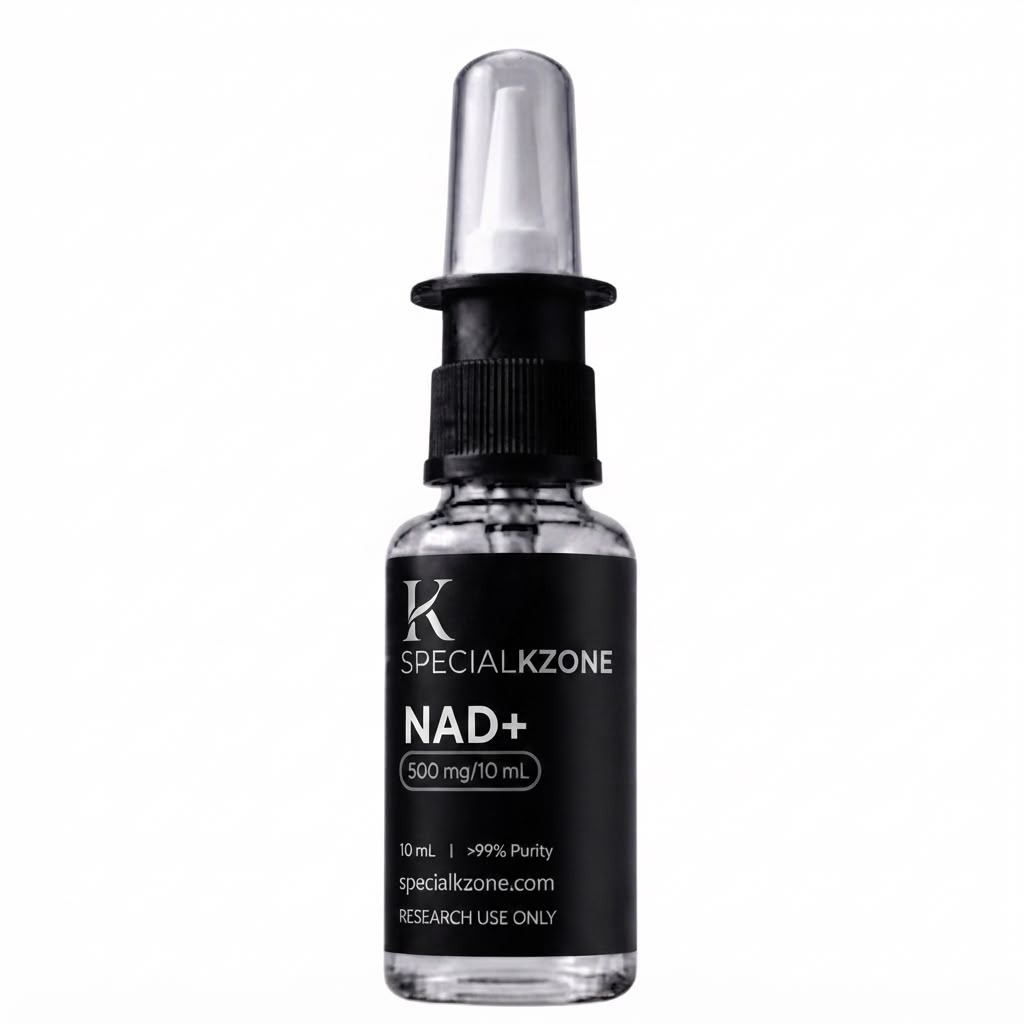
NAD+ Spray – Intranasal Nicotinamide Adenine Dinucleotide for CNS & Metabolic Research
Intro Paragraph (250 words)
Our pharmaceutical-grade NAD+ Spray delivers nicotinamide adenine dinucleotide through an advanced intranasal formulation designed to bypass the blood-brain barrier constraints and hepatic first-pass metabolism that limit oral bioavailability. While traditional NAD+ administration—whether as lyophilized powder requiring reconstitution with bacteriostatic water or intravenous infusion—faces rapid systemic clearance and limited cerebral penetration, this metered-dose nasal spray exploits the direct anatomical connections between the nasal cavity and central nervous system to achieve rapid neuronal uptake. This delivery method proves particularly critical for research into neurodegenerative diseases, cognitive decline, and addiction medicine, where cerebral NAD+ depletion correlates with mitochondrial dysfunction and sirtuin inactivation, yet systemic administration fails to restore optimal brain levels.
The NAD+ Spray format addresses a fundamental limitation of NAD+ therapeutics: the molecule’s large size and ionic charge prevent efficient transport across the blood-brain barrier via peripheral circulation. By administering directly to the olfactory and respiratory mucosa, researchers can achieve therapeutically relevant concentrations in the cerebrospinal fluid and brain parenchyma within minutes, enabling investigation into acute neuroprotection, synaptic plasticity enhancement, and the resolution of “brain fog” associated with metabolic syndrome or chronic fatigue models. This non-invasive approach eliminates the compliance barriers and tissue trauma associated with intravenous protocols while providing superior CNS targeting compared to enteral administration, where gastric acids and brush-border enzymes degrade the dinucleotide to nicotinamide and ADP-ribose.
For laboratories studying the “NAD World” hypothesis of aging, mitochondrial dysfunction in neurons, or the emerging role of NAD+ in addiction neurobiology, this spray format offers a methodological bridge between basic biochemistry and clinical application, allowing for chronic administration protocols that maintain sustained cerebral NAD+ levels without the peaks and troughs associated with bolus injections.
Nose-to-Brain Delivery Mechanisms & CNS Bioavailability
The NAD+ Spray leverages two primary pathways for CNS entry: the olfactory neural pathway and the trigeminal nerve pathway. The olfactory epithelium, located in the superior nasal cavity, contains bipolar neurons whose axons project directly through the cribriform plate into the olfactory bulb, bypassing the restrictive blood-brain barrier entirely. When NAD+ is deposited on this specialized mucosa, it can be internalized by olfactory sensory neurons and transported via axonal transport to the olfactory bulb, subsequently distributing to limbic structures, the hypothalamus, and cortical regions through standard neuroanatomical connections.
Trigeminal Pathway Contribution:
The trigeminal nerve innervates the respiratory and anterior nasal mucosa, providing another direct route to the brainstem and pons. Through this pathway, NAD+ can reach the locus coeruleus and reticular activating system, structures critical for arousal, attention, and autonomic regulation. This dual innervation ensures that intranasal NAD+ achieves broader CNS distribution than single-pathway delivery methods, making it suitable for research into global cerebral energetics rather than region-specific targeting.
Avoiding Systemic Degradation:
Peripheral administration of NAD+ faces rapid hydrolysis by ectoenzymes CD38 and CD157, which cleave the dinucleotide to nicotinamide and ADP-ribose before it can reach neuronal tissues. While the NAD+ powder format requires intravenous or intraperitoneal injection to achieve systemic levels, the NAD+ Spray minimizes exposure to these circulating NADases by entering the brain before significant dilution into systemic circulation. Research indicates that intranasal delivery can achieve CSF concentrations 10-100 times higher than equivalent intravenous doses for certain peptides and small molecules, a pharmacokinetic advantage that proves critical for studying sirtuin activation and PARP-mediated DNA repair in neuronal populations.
Comparison to Oral Delivery:
Oral NAD+ administration faces near-complete degradation by gastric acids and intestinal brush-border nucleotidases, with remaining nicotinamide requiring conversion back to NAD+ through the rate-limiting NAMPT enzyme (which declines with age). The intranasal route bypasses these metabolic bottlenecks entirely, delivering intact NAD+ directly to energy-deficient neurons.
Research Applications & Neurological Models
Neurodegenerative Disease Research:
The primary application for NAD+ Spray involves Alzheimer’s, Parkinson’s, and Huntington’s disease models, where cerebral NAD+ levels drop precipitously due to increased consumption by hyperactive PARPs (attempting DNA repair) and CD38 (inflammatory signaling). Research indicates that restoring neuronal NAD+ can prevent axonal degeneration by maintaining mitochondrial membrane potential and supporting SIRT3-mediated antioxidant defenses. Unlike [MOTS-c](https://specialkzone.com/product/mots-c/), which stimulates mitochondrial biogenesis through mitokine signaling, NAD+ provides the actual substrate for oxidative phosphorylation and sirtuin activity, potentially offering more immediate bioenergetic rescue in acute neurodegenerative insults.
Cognitive Enhancement & Brain Fog:
For metabolic syndrome and chronic fatigue syndrome (CFS/ME) research, the NAD+ Spray format allows investigation into whether cerebral energy crisis—manifesting as cognitive slowing, attention deficits, and memory impairment—can be rapidly corrected through direct neuronal NAD+ restoration. Studies focus on psychometric testing improvements following intranasal administration, comparing the speed of cognitive recovery versus dietary precursor supplementation (NMN, NR) which requires days to weeks for CNS level elevation.
Addiction & Withdrawal Research:
NAD+ has emerged as a research tool for substance use disorders, particularly alcohol and opioid withdrawal, where it may reduce withdrawal severity through restoration of hypothalamic-pituitary-adrenal axis function and reduction of neuroinflammation. The NAD+ Spray format enables investigation into whether rapid CNS NAD+ restoration can prevent kindling phenomena or reduce craving intensity, offering a non-invasive alternative to the intravenous NAD+ protocols historically used in addiction medicine research.
Stroke & Acute Brain Injury:
In ischemia-reperfusion models, rapid NAD+ administration immediately post-injury can prevent the energetic collapse that triggers necrotic and apoptotic cascades. The spray format’s rapid onset makes it suitable for emergency research protocols where intravenous access may be delayed or impractical, potentially offering neuroprotection during the critical “golden hour” of stroke management.
Comparative Pharmacology: Intranasal vs. Alternative Routes
NAD+ Spray vs. NAD+ Powder (Injectable):
While the NAD+ powder product allows flexible dosing and intravenous administration for systemic metabolic research, the NAD+ Spray specifically targets CNS applications. IV administration produces high plasma levels but poor brain penetration due to the blood-brain barrier; intranasal delivery produces lower plasma levels but significantly higher CSF concentrations. Researchers choose the spray format for neurological endpoints, reserving injectable NAD+ for peripheral metabolic studies (liver, muscle, adipose tissue).
NAD+ Spray vs. DSIP Spray:
Both utilize intranasal delivery, but for fundamentally different research objectives. [DSIP Spray](#] targets sleep architecture and HPA axis modulation through peptide signaling in the diencephalon, producing sedative and stress-protective effects. NAD+ Spray targets cellular energetics and sirtuin activation, producing alerting, metabolic, and neuroprotective effects. The combination of these two sprays—one administered evening, one morning—represents a potential research protocol for investigating circadian metabolic regulation and sleep-dependent cognitive restoration.
NAD+ Spray vs. Oral Precursors (NMN/NR):
Nicotinamide mononucleotide (NMN) and nicotinamide riboside (NR) have gained popularity as oral NAD+ precursors, but they require cellular uptake and enzymatic conversion (via NMNAT) to active NAD+. This conversion is inefficient in neurons and declines with age. The NAD+ Spray delivers the active coenzyme directly, bypassing enzymatic bottlenecks and potentially offering more reliable CNS bioavailability, though research continues to compare the relative efficacy of direct versus precursor administration for neuronal NAD+ elevation.
Product Specifications & Formulation Stability
- Active Compound: Nicotinamide Adenine Dinucleotide (NAD+, oxidized form)
- Delivery System: Metered-dose nasal spray pump
- Total Content: Varies by concentration (typically 100-200mg total NAD+ per bottle)
- Concentration: Approximately 10-20mg/ml (aqueous solution)
- Dosing per Actuation: ~0.1ml per spray (1-2mg NAD+ per spray)
- Formulation: Isotonic saline solution with pH buffering (pH 6.5-7.5)
- Preservatives: Benzalkonium chloride or similar antimicrobial agent
- Stability: 30 days refrigerated at 2-8°C after opening; do not freeze
- Storage: 2-8°C (refrigerated), protect from light
Quality Control:
Each batch tested for sterility, endotoxin levels (<0.5 EU/ml), osmolarity (280-320 mOsm/kg), and pH stability. NAD+ content verified via UV spectrophotometry (259nm absorption) and HPLC to ensure absence of degradation products (nicotinamide, ADP-ribose). The aqueous stability is inherently lower than lyophilized powder, necessitating the shorter shelf life and refrigeration requirements.
Administration Protocols & Research Methodologies
Standardized Administration Technique:
For reproducible research outcomes, instruct subjects to: (1) Clear nasal passages; (2) Shake bottle gently; (3) Tilt head slightly forward (not backward, to prevent swallowing); (4) Insert nozzle into nostril and aim toward the outer wall (superior turbinate region); (5) Actuate while inhaling gently; (6) Hold breath for 10 seconds to maximize mucosal contact; (7) Avoid blowing nose for 15 minutes post-administration.
Dosing Frequency:
Due to the short half-life of NAD+ and continuous enzymatic degradation by nasal ectoenzymes, research protocols typically employ 2-4 sprays per nostril, 2-3 times daily, to maintain sustained cerebral levels. This frequent dosing is feasible given the non-invasive nature of the spray format, unlike intravenous protocols that require clinical supervision.
Timing Considerations:
Morning and midday administration is preferred due to the alerting effects of NAD+ on the reticular activating system. Evening dosing may interfere with sleep architecture unless combined with sleep-promoting agents like [DSIP Spray](#].
Combination Research:
Studies often combine NAD+ Spray with MOTS-c administration to investigate whether enhanced mitochondrial biogenesis signaling (MOTS-c) synergizes with improved energy substrate availability (NAD+) in neurodegenerative models. This combination addresses both the signaling deficits and the bioenergetic collapse characteristic of aging neurons.
Frequently Asked Research Questions
How does intranasal NAD+ compare to IV infusion for brain levels?
Research suggests intranasal delivery achieves higher CSF-to-plasma ratios than IV administration due to direct olfactory transport bypassing the blood-brain barrier. While IV produces higher absolute plasma levels, intranasal delivery is more efficient for CNS targeting with lower total doses.
What causes the burning sensation sometimes reported?
Mild transient burning or tingling is common with NAD+ administration (regardless of route) due to activation of purinergic receptors (P2X) and capsaicin-sensitive neurons. This sensation typically resolves within 1-2 minutes and is considered a normal pharmacodynamic response rather than an adverse effect.
Can NAD+ Spray be combined with other nasal peptides?
Yes, though timing should be separated by 15-30 minutes to prevent mucosal saturation and ensure adequate absorption of each compound. Combining with [DSIP Spray](#] (evening) and NAD+ Spray (morning) represents a common research protocol for circadian optimization.
Is this stable for long-term storage?
No, the aqueous formulation has limited stability compared to lyophilized [NAD+ powder](#]. Use within 30 days of opening and maintain continuous refrigeration. Do not freeze, as ice crystals disrupt the pump mechanism and cause NAD+ precipitation.
How does this differ from NMN or NR sprays?
NAD+ Spray delivers the active coenzyme directly, while NMN/NR sprays require cellular conversion. Direct NAD+ may offer faster onset for acute neuroprotection research, while precursors may provide more sustained elevation through cellular uptake and processing.
Reviews
There are no reviews yet.