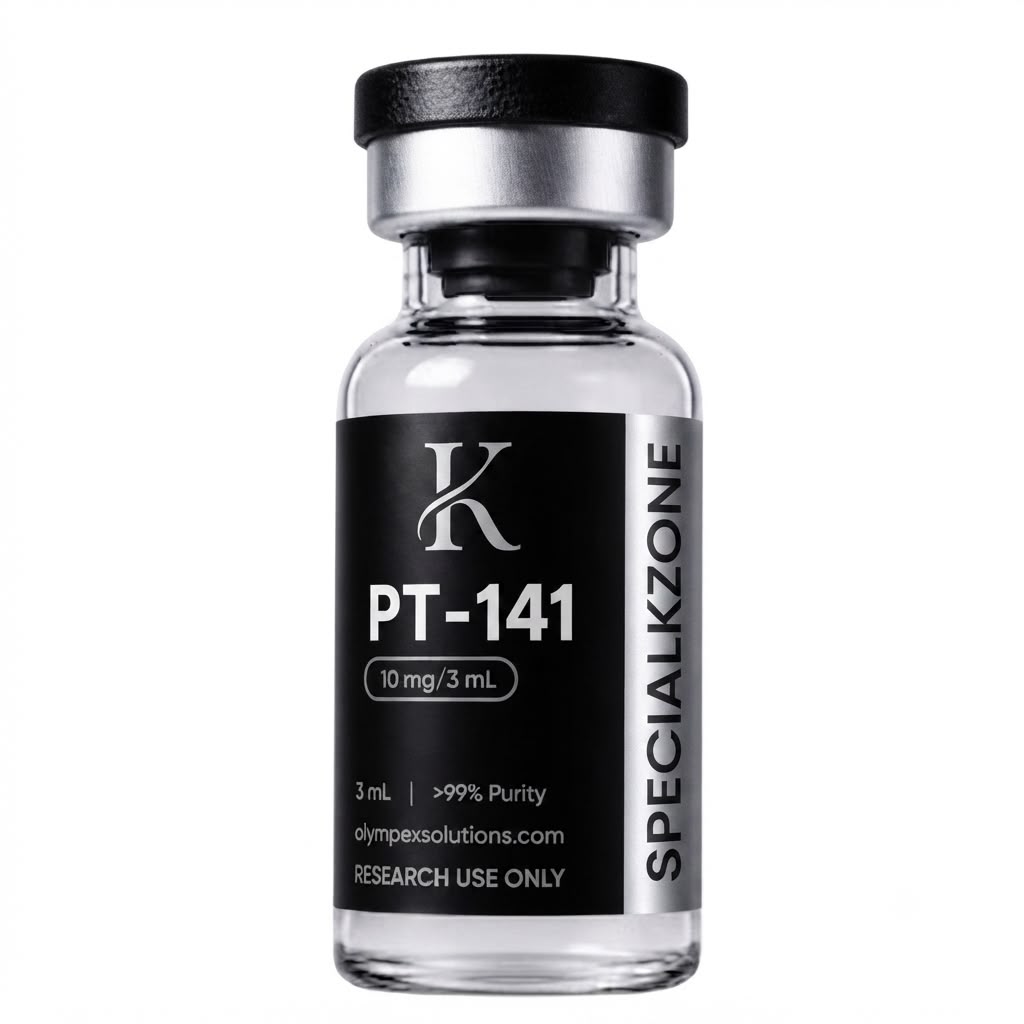
PT-141 (Bremelanotide) 10mg – Melanocortin Agonist for Sexual Dysfunction Research
Our pharmaceutical-grade PT-141 (Bremelanotide) represents the clinically validated evolution of melanocortin-based sexual dysfunction research, delivering a modified melanotropin specifically engineered for investigation into female sexual interest/arousal disorder (FSIAD), hypoactive sexual desire disorder (HSDD), and psychogenic erectile dysfunction. Unlike its parent compound [Glow (Melanotan II)](https://specialkzone.com/product/glow/), which stimulates melanogenesis alongside sexual arousal through multi-receptor promiscuity, Bremelanotide has been structurally optimized to eliminate cutaneous tanning effects while enhancing selectivity for the melanocortin-4 receptor (MC4R) mediating sexual behavior. This 10mg lyophilized preparation provides researchers with the identical sequence (Ac-Nle-cyclo[Asp-His-D-Phe-Arg-Trp-Lys]-OH) that achieved FDA approval for premenopausal FSIAD, offering a pharmaceutical-grade standard for investigating the central neurobiology of sexual motivation distinct from peripheral vasodilators like PDE5 inhibitors.
PT-141 operates through a fundamentally different mechanism than traditional erectile dysfunction treatments, targeting hypothalamic and limbic MC4R populations to activate mesolimbic dopaminergic pathways—the “reward circuitry” essential for sexual desire and arousal. This central mechanism addresses psychogenic and libidinal aspects of sexual dysfunction that phosphodiesterase inhibitors cannot influence, making it essential for research into the brain-based etiologies of sexual disorders. When reconstituted with [bacteriostatic water](#], this cyclic heptapeptide enables investigation into the neuroendocrine regulation of sexual behavior, including the intersection of stress, depression, and reward circuitry that characterizes modern sexual medicine research.
For behavioral pharmacology laboratories and sexual psychophysiology researchers, PT-141 offers a probe for dissociating sexual desire (central dopaminergic activation) from sexual performance (peripheral hemodynamics), while providing insights into how melanocortin signaling interfaces with oxytocin, norepinephrine, and endogenous opioid systems to coordinate sexual motivation across gender and hormonal status.
Central Mechanisms of Sexual Arousal
Bremelanotide (Ac-Nle-cyclo[Asp-His-D-Phe-Arg-Trp-Lys]-OH, MW 1,025.2 Da) functions as a potent, selective agonist at melanocortin-4 receptors (MC4R) expressed in the medial preoptic area (MPOA), ventromedial hypothalamus, and nucleus accumbens—brain regions integral to sexual motivation, arousal, and reward. Unlike the broader receptor profile of [Melanotan 2](#], which activates MC1R (tanning), MC3R (metabolism), and MC5R (exocrine) alongside MC4R, PT-141 has been modified to enhance MC4R specificity, reducing off-target effects while maintaining robust pro-sexual efficacy.
Dopaminergic Activation:
MC4R stimulation by PT-141 increases dopamine release in the mesolimbic pathway, particularly the nucleus accumbens shell and medial preoptic area. This dopaminergic enhancement increases sexual motivation and incentive salience of sexual stimuli, distinct from the hemodynamic mechanisms of PDE5 inhibitors. Research indicates that Bremelanotide can restore lordosis behavior in female animal models and increase intromission frequency in males through these dopaminergic mechanisms, even in castrated models where hormonal interventions fail—suggesting a hormone-independent pathway for sexual function restoration.
HPA Axis Modulation:
Sexual dysfunction often correlates with chronic stress and elevated corticotropin-releasing factor (CRF). PT-141 research investigates whether MC4R activation can modulate the hypothalamic-pituitary-adrenal axis, potentially reducing stress-induced sexual inhibition. This mechanism contrasts with [DSIP Spray](#], which modulates sleep and stress through delta-wave induction and GABA-ergic tone, offering a complementary approach to stress-related sexual dysfunction research.
Sympathetic Activation:
Bremelanotide increases sympathetic nervous system outflow, producing physiological arousal (increased heart rate, blood pressure, genital blood flow) through central autonomic activation rather than peripheral vasodilation. This central-peripheral integration proves crucial for research into the psychosomatic aspects of sexual arousal, where psychological desire must translate to physical response through autonomic coordination.
Research Applications & Therapeutic Models
Female Sexual Interest/Arousal Disorder (FSIAD):
The primary research application for PT-141 involves FSIAD and HSDD in female models, conditions characterized by absent or reduced sexual interest causing significant distress. Unlike testosterone therapy or estrogen modulation, Bremelanotide addresses the central motivational deficits of FSIAD through dopaminergic activation, increasing “wanting” and responsiveness to sexual cues. Research protocols examine latency to sexual behavior, solicitation behaviors, and subjective arousal measures (in human clinical translation studies), providing a pharmacological tool for investigating the neural substrates of female sexual motivation distinct from hormonal status.
Psychogenic Erectile Dysfunction:
While PDE5 inhibitors effectively treat vascular erectile dysfunction, they fail in cases where performance anxiety, depression, or relationship discord underlies the pathology. PT-141 research investigates centrally-mediated erectile function through spinal cord MC4R activation and psychogenic arousal enhancement, offering a research model for “mind-body” erectile dysfunction where psychological factors predominate over vascular insufficiency. Studies compare Bremelanotide to [CJC-1295 No DAC](#]-mediated GH enhancement, examining whether sexual dysfunction correlates more strongly with central neurochemistry or peripheral metabolic/anabolic status.
Sexual Side Effects of Antidepressants:
SSRIs and SNRIs frequently induce sexual dysfunction through serotonergic suppression of dopaminergic pathways. PT-141 research investigates whether melanocortin agonism can override SSRI-induced sexual inhibition, potentially serving as an adjunct therapy for maintaining sexual function during antidepressant treatment. Studies focus on the interaction between 5-HT2C receptor antagonism (by some antidepressants) and MC4R agonism in restoring sexual reward sensitivity.
Addiction & Compulsive Behavior:
Paradoxically, while PT-141 enhances sexual motivation in dysfunctional contexts, research also examines its potential in addiction medicine—specifically whether restoring “natural” reward sensitivity through melanocortin activation can reduce cravings for drug rewards by normalizing mesolimbic dopamine tone. This application contrasts with [NAD+ Spray](#] research in addiction, which focuses on bioenergetic restoration and withdrawal symptom management.
Product Specifications & Structural Modifications
- Chemical Name: Bremelanotide; PT-141; [Nle⁴, D-Phe⁷]-α-MSH(4-10)-lactam, C-terminal acid
- Sequence: Ac-Nle-cyclo[Asp-His-D-Phe-Arg-Trp-Lys]-OH (C-terminal free acid vs. amide in MT-II)
- Structure: Cyclic heptapeptide (Asp-Lys lactam bridge)
- Molecular Formula: C₅₀H₆₈N₁₄O₁₀
- Molecular Weight: 1,025.16 g/mol
- Total Content: 10mg per vial (lyophilized powder)
- Key Modification: C-terminal carboxylic acid (vs. amide in MT-II) enhances metabolic stability and MC4R selectivity
- Purity: ≥99% (HPLC verified)
- Appearance: White to off-white lyophilized powder
- Solubility: Soluble in aqueous solutions, optimal in slightly acidic pH (5-6)
- Storage: -20°C stable (lyophilized), 2-8°C after reconstitution
- Reconstituted Stability: 14 days at 2-8°C when prepared with preservatives
Structural Distinction from MT-II:
The critical difference from [Melanotan 2](#] lies in the C-terminal modification (free acid vs. amide) and subtle conformational constraints that enhance MC4R binding while reducing MC1R affinity. This eliminates the tanning response while preserving—and potentially enhancing—sexual arousal effects, providing a “cleaner” pharmacological tool for sexual dysfunction research without the pigmentary confounds of earlier melanotropins.
Reconstitution & Administration Protocols
Preparation Guidelines:
Reconstitute PT-141 10mg with 1-2ml of bacteriostatic water containing 0.6% acetic acid to create a 5-10mg/ml stock solution at pH ~5.0. The cyclic structure requires gentle handling—avoid vigorous vortexing that might disrupt the lactam bridge. The free acid form demonstrates slightly better aqueous stability than the C-terminal amide of MT-II, though protection from light remains essential to prevent tryptophan oxidation.
Dosing Parameters:
Research concentrations typically range from 0.5-2mg per administration in human clinical equivalent models, though animal studies may utilize 0.1-0.5mg/kg depending on species and route. Onset of action occurs within 30-60 minutes, with peak effects at 1-2 hours and duration of 4-6 hours—shorter than the extended effects of subcutaneous [Melanotan 2](#] due to metabolic modifications enhancing clearance.
Route Considerations:
Subcutaneous injection remains standard for research protocols, though intranasal formulations (similar to MT-2 Spray have been investigated for enhanced CNS penetration and rapid onset. The PT-141 vial format allows flexible route selection depending on research objectives—subcutaneous for systemic pharmacokinetic studies, intranasal for rapid CNS targeting.
Combination Research:
Studies often examine PT-141 in combination with oxytocin (social bonding enhancement) or phosphodiesterase inhibitors (combined central desire and peripheral performance), investigating synergistic effects on sexual satisfaction beyond arousal alone.
Comparative Analysis: PT-141 vs. Alternative Interventions
PT-141 vs. Melanotan II:
While [Glow (Melanotan II)](https://specialkzone.com/product/glow/) produces sexual arousal alongside tanning, appetite suppression, and blood pressure changes, PT-141 isolates the pro-sexual effects through enhanced MC4R selectivity. Research comparing these compounds investigates whether the tanning and metabolic effects of MT-II confound sexual behavior data, and whether Bremelanotide’s “cleaner” profile offers superior safety margins for chronic sexual dysfunction research.
PT-141 vs. PDE5 Inhibitors (Sildenafil/Tadalafil):
Phosphodiesterase inhibitors enhance erectile function through peripheral vasodilation (cGMP accumulation) but do not increase sexual desire or arousal. PT-141 research demonstrates that central MC4R agonism can increase both desire and physiological arousal in the absence of vascular disease, offering a mechanistic distinction between “performance” and “motivation” in sexual dysfunction models. Combination studies investigate whether central arousal (PT-141) plus peripheral vasodilation (PDE5i) produces superior outcomes to either alone.
PT-141 vs. Hormonal Therapies:
Testosterone and estrogen therapies require intact hormonal axes and carry risks of cardiovascular events or oncogenicity. PT-141 operates through central neurochemistry independent of gonadal steroid status, making it valuable for research into sexual dysfunction in hypogonadal models, post-menopausal subjects, or androgen-deprivation therapy patients where hormonal manipulation is contraindicated.
Safety Considerations & Research Limitations
Nausea and Emesis:
The most common side effect in PT-141 research is nausea, mediated by MC4R activation in the area postrema of the medulla oblongata. This effect is dose-dependent and typically transient (30-60 minutes), but requires antiemetic protocols or dose optimization in sensitive models. Unlike [Melanotan 2](#], which produces more severe nausea due to broader receptor activation, Bremelanotide demonstrates improved tolerability while maintaining efficacy.
Cardiovascular Hemodynamics:
PT-141 increases blood pressure and heart rate through sympathetic activation, requiring cardiovascular monitoring in research protocols, particularly in models with hypertension or cardiovascular disease. This pressor effect distinguishes it from [DSIP Spray](#], which generally reduces blood pressure through parasympathetic enhancement.
Hyperpigmentation Risk:
Despite reduced MC1R affinity compared to [Melanotan 2](#], chronic high-dose PT-141 administration may still produce mild darkening of existing moles or diffuse hyperpigmentation in susceptible models, requiring dermatological monitoring during extended research protocols.
Frequently Asked Research Questions
How does PT-141 differ from Melanotan II?
PT-141 (Bremelanotide) is the C-terminal acid analog of MT-II with enhanced MC4R selectivity, eliminating tanning effects while preserving sexual arousal properties. The structural modification (free acid vs. amide) enhances metabolic stability and reduces receptor promiscuity.
Can PT-141 treat vascular erectile dysfunction?
While PT-141 increases genital blood flow through sympathetic activation, it is not a vasodilator like PDE5 inhibitors. Research indicates it is most effective for psychogenic or neurogenic dysfunction where central arousal deficits predominate over vascular insufficiency.
What is the onset time for behavioral effects?
Sexual arousal and motivation typically manifest within 30-60 minutes of subcutaneous administration, with peak effects at 1-2 hours. Intranasal administration (off-label in research) may accelerate onset to 15-30 minutes due to direct CNS penetration.
Does PT-141 require sexual stimulation to work?
Unlike PDE5 inhibitors which require sexual stimulation to enhance erection, PT-141 actively increases sexual desire and responsiveness to stimuli through dopaminergic activation. It produces pro-active rather than reactive sexual motivation in research models.
Can this be combined with hormone therapies?
Yes, research often combines PT-141 with testosterone or estrogen protocols to investigate whether hormonal priming enhances melanocortin responsiveness, or whether Bremelanotide can restore function in hormone-deficient models independent of replacement therapy.
-
Compound: PT-141
-
Quantity: 10 mg
-
Purity: ≥99% (HPLC Certified)
-
Form: Lyophilized powder
-
Appearance: White to off-white powder
-
Solubility: Soluble in laboratory-grade sterile water
-
COA: Included in product image gallery
Reviews
There are no reviews yet.